
336 million spins on wanted dead or a wild: the median $0.50/$100 session ended with 32 cents
exp · 002 (+ addendum 002a) · 2026-06-12 · simulation-based
last updated 2026-06-12
Run it yourself in the live simulator. All figures are simulation-based observations, not predictions. See our methodology.
what we measured
| parameter | value |
|---|---|
| simulated rtp version | 96.38%, provider default. the game also ships at 94.55 / 92.33 / 88.42 (all provider-published; see "the rtp version lottery") |
| stakes | $0.20 / $0.50 / $1.00 per spin |
| bankrolls | $50 / $100 / $200 |
| sessions per combo | 10,000 (90,000 sessions, 88,097,029 spins total) |
| spin cap | 2,000 spins per session |
| model | wdoaw-v1, high volatility, 19.3% hit frequency (third-party figure; hacksaw doesn't publish one), 12,500x cap |
| addendum: rtp-variant grids | full grid re-run at 94.55 / 92.33 / 88.42, 10,000 sessions per cell, 248,143,051 spins; hit rate, volatility and bonus structure held constant (assumption, see "the rtp version lottery") |
| addendum: bonus-buy module | three buy modes at $0.50 stake (great train robbery 80x / duel at dawn 200x / dead man's hand 400x), $50/$100/$200 bankrolls, 10,000 sessions per cell, 500-buy cap; 885,245 simulated buys |
the question: at the game's best published rate, how long does a real-world bankroll last, and what does the wait between bonuses cost on the way? the addendum adds two more: what buying the bonus repeatedly does to a bankroll, and what the lower rtp versions actually cost in session terms.
how long bankrolls survived
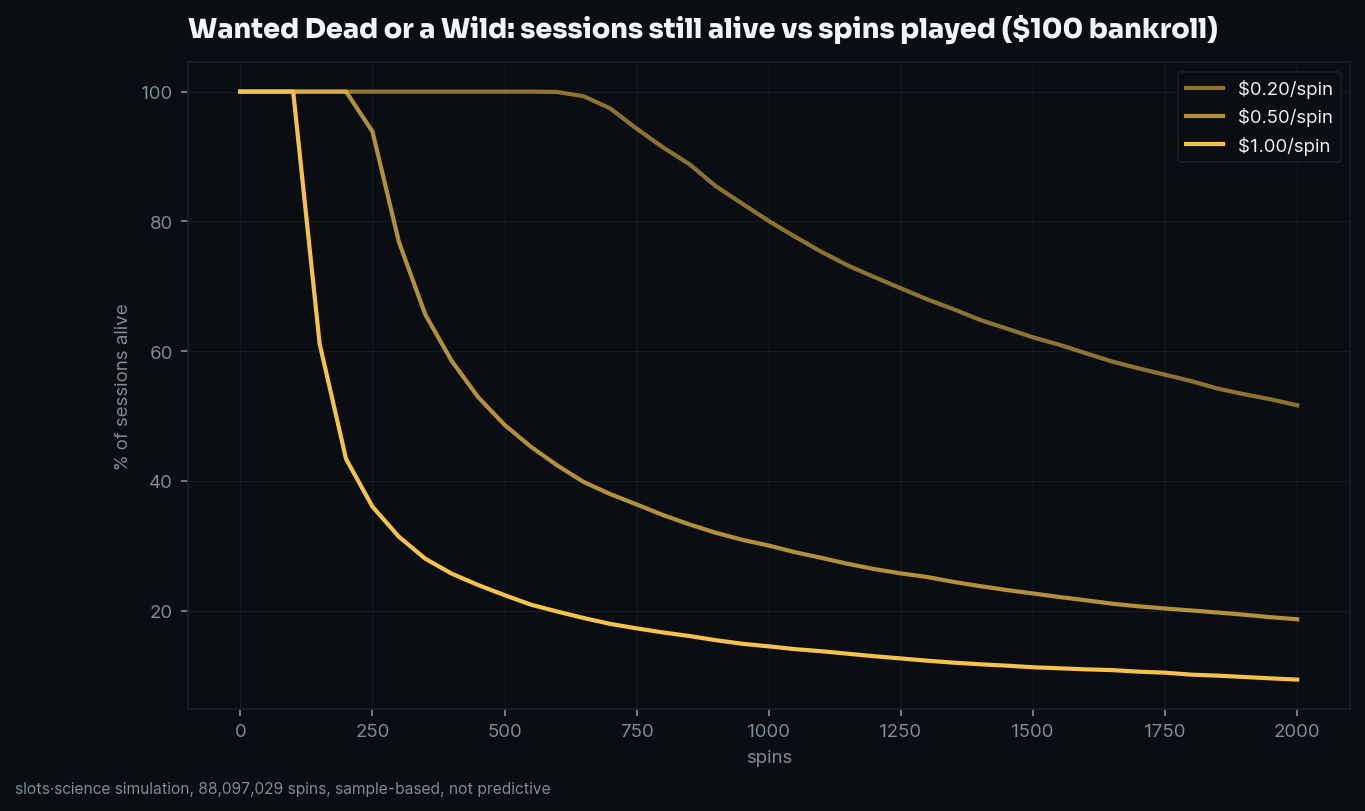
three observations from the $100-bankroll curves. at $1.00 a spin, half of all sessions were dead by spin 175; the curve falls off a cliff in the first 300 spins and barely 9% of sessions reached the cap. at $0.50, the median session lasted 484 spins, about an hour and a half of normal play (at ~5 spins a minute), before the same slide. at $0.20, the median session was still alive at the 2,000-spin cap; stake-to-bankroll ratio, not the slot, decided everything we measured.
bust rates
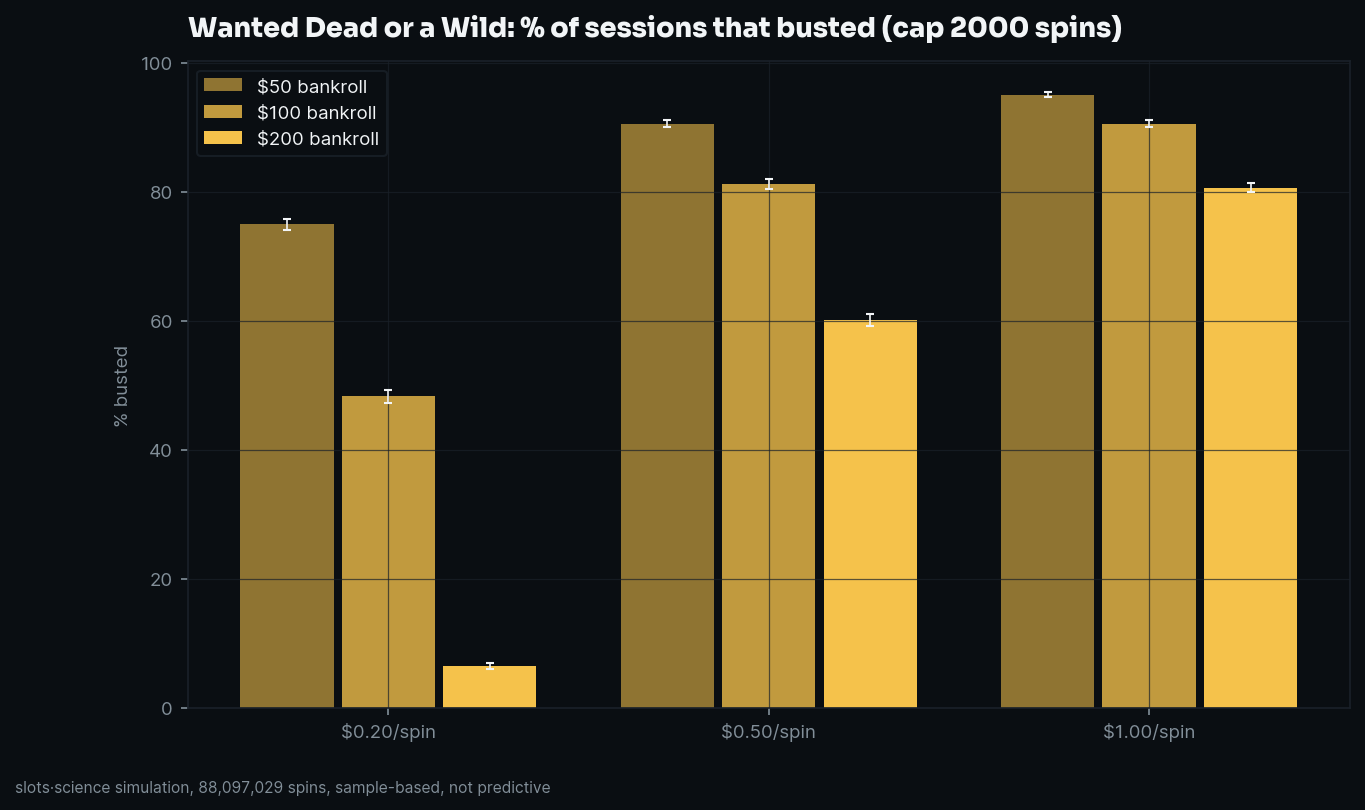
% of sessions that busted before the 2,000-spin cap (95% CI):
| $50 bankroll | $100 bankroll | $200 bankroll | |
|---|---|---|---|
| $0.20/spin | 75.0% ±0.9 | 48.3% ±1.0 | 6.5% ±0.5 |
| $0.50/spin | 90.6% ±0.6 | 81.3% ±0.8 | 60.2% ±1.0 |
| $1.00/spin | 95.1% ±0.4 | 90.6% ±0.6 | 80.7% ±0.8 |
plain reading: every step up in stake at a fixed bankroll raised the bust rate, by as little as 4.5 points ($0.50→$1.00 against $50) and as much as 54 points ($0.20→$0.50 against $200). $1.00 against $50, 50 spins of cover, busted 95 times in 100. the only combination that reliably survived was 1,000 spins of cover ($0.20 against $200), and even there one session in fifteen went to zero.
the bonus wait
across the full sample the three bonus modes (train robbery, duel at dawn, dead man's hand combined) triggered 370,207 times, once every 238.0 spins on average (±0.8, 95% CI). under the model's trigger process, waits are geometric: about 12% of bonus-to-bonus gaps run past 500 spins and roughly 1.5% past 1,000. the cost of the average wait scales with stake: $48 at $0.20 a spin, $238 at $1.00. which is why the $1.00/$50 cell is so bleak, its median session lasted 72 spins, and a 72-spin session sees no bonus at all about three times in four. note the trigger rate itself is a calibrated estimate (see methodology); the session-level consequences above are what the experiment measured.
the bonus buy math
all three bonuses are directly purchasable (not in the uk market, outside our geos in any case). we simulated the obvious strategy: at a $0.50 stake, buy the feature, collect, buy again, until the bankroll can't cover another buy or 500 buys pass. 10,000 sessions per cell. the published buy rtps (96.27% / 96.33% / 96.43%) are model inputs, not findings; what the experiment measures is what repeat-buying does to a bankroll. one modelling note up front: the spec rates the three modes at different volatility, but hacksaw publishes no per-mode payout spread, so all three were simulated with the same spread assumption, differences between modes below are price effects, not volatility effects.
| mode | cost at $0.50 | bankroll (buys affordable at start) | couldn't rebuy (95% ci) | median buys survived | ever ahead | finished ahead | median final |
|---|---|---|---|---|---|---|---|
| great train robbery | $40 | $50 (1) | 99.4% ±0.2 | 1 | 28.9% | 0.6% | $22.44 |
| $100 (2) | 98.3% ±0.3 | 5 | 47.6% | 1.7% | $28.34 | ||
| $200 (5) | 95.3% ±0.4 | 18 | 65.9% | 4.6% | $28.21 | ||
| duel at dawn | $100 | $100 (1) | 99.5% ±0.1 | 1 | 26.9% | 0.5% | $40.50 |
| $200 (2) | 98.9% ±0.2 | 3 | 42.9% | 1.1% | $62.88 | ||
| dead man's hand | $200 | $200 (1) | 99.5% ±0.1 | 1 | 27.0% | 0.5% | $81.12 |
(at this stake a $50 bankroll can't buy duel at dawn at all, and only the $200 bankroll can buy dead man's hand, those cells aren't outcomes, they're arithmetic.)
"couldn't rebuy" is not busting to zero: the session ends when the next buy is unaffordable, usually with change left, the median $200 train-robbery session ended with $28.21 in the wallet, just not $40.
the per-buy reality (payout distribution is a model-based estimate; the mean tracks the published buy rtp by construction):
| mode | cost | median payout | buys that paid less than cost | paid less than half cost | p90 | p99 |
|---|---|---|---|---|---|---|
| great train robbery | 80x | 37.5x | 73.7% | 52.1% | 174.4x | 607.4x |
| duel at dawn | 200x | 93.4x | 73.7% | 52.2% | 434.5x | 1,513.1x |
| dead man's hand | 400x | 187.5x | 73.4% | 52.1% | 876.0x | 2,981.0x |
(n = 504,434 / 294,750 / 86,061 simulated buys per mode.)
the cheap-vs-expensive comparison: under our uniform-spread assumption, every mode's median buy returned about 47% of its cost, and roughly three buys in four lost money. what the price changes is endurance, not expectation. the same $200 bankroll bought a median of 18 train robberies and was ahead of its starting point at some moment in 65.9% of sessions; pointed at dead man's hand, it gets exactly one $200 pull, and 99.5% ±0.1 of sessions couldn't fund a second. yet the finish line barely moves, 4.6% of $200 train-robbery sessions ended in profit against 0.5% for dead man's hand. the gap between "ever ahead" (65.9%) and "finished ahead" (4.6%) is the signature of the strategy we simulated: it never stops while ahead, so interim profits get re-spent. the tail is why anyone buys at all: the 99th-percentile dead man's hand buy paid 2,981x the stake, about 7.5x its cost, and all three modes hit the 12,500x cap at least once in sample.
what a finished session looks like
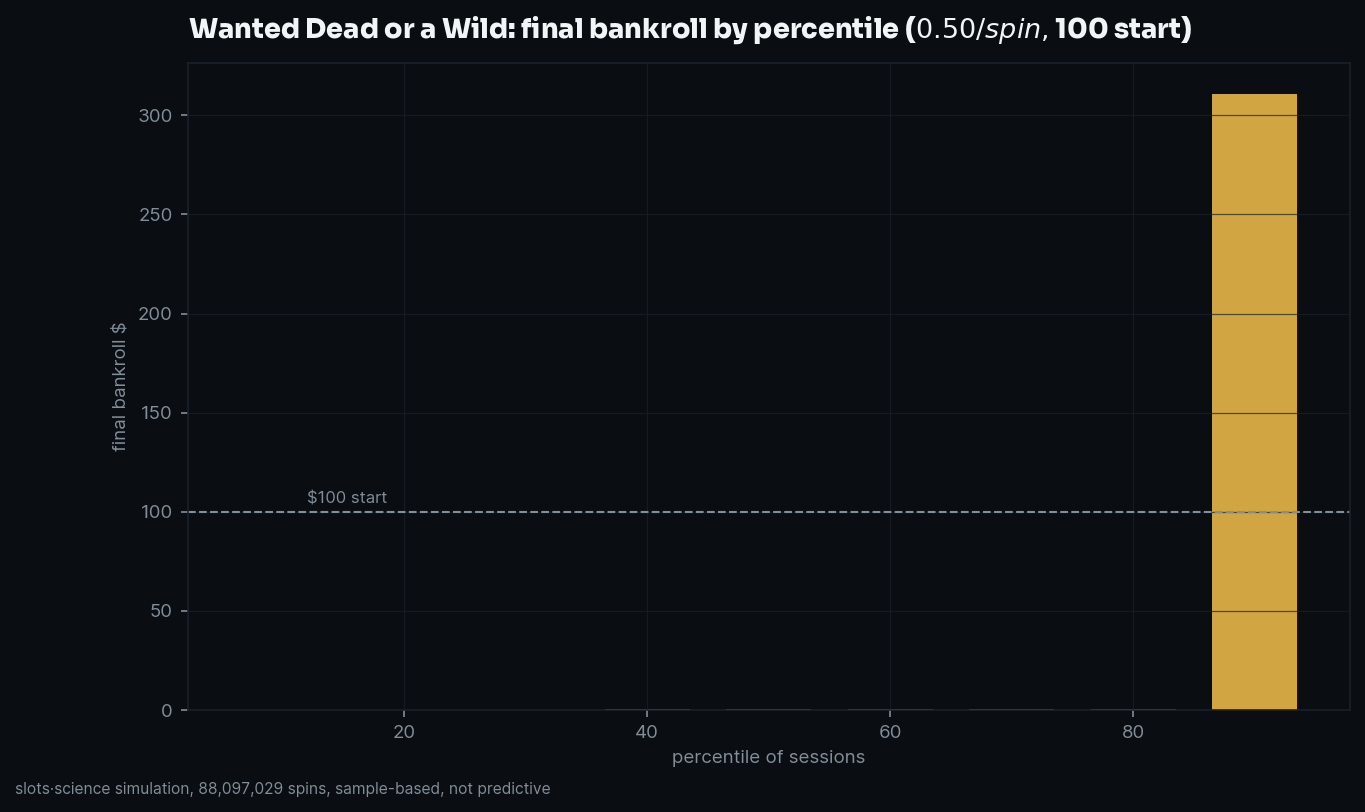
the $0.50/$100 cell, by percentile: half of all sessions ended below $0.32. eighty percent ended below $0.50, less than one spin. the 90th percentile kept $310.72. there is almost nothing in between: this game's sessions end busted or they end ahead, and the dead streaks along the way are long, one session in ten saw a dead run of 33 or more consecutive spins, and the longest we observed anywhere in 90,000 sessions was 73 (a sample observation, not a distribution claim).
the rtp version lottery
everything above was simulated at 96.38%, the provider default and the best published version of this game. hacksaw also publishes it at 94.55, 92.33 and 88.42: a 7.96pp spread, among the widest in our database. slotcatalog currently tracks 94.55 as the game's headline rate, which suggests sub-default deployment is common in the wild, and at least one operator (betfury) advertises the version right in the game title ("wanted dead or a wild 96%"). the first version of this study said only that lower versions are directionally worse. the addendum measured it.
what the rtp version lottery costs
we recalibrated the model at each published variant and re-ran the full nine-cell grid, 10,000 sessions per cell, 248.1 million additional spins, each variant model passing the same validation gate as the default (analytic rtp exact at target; 10-million-spin check within sampling noise). one assumption to keep in view: hacksaw publishes the variant rtps but not per-variant mechanics, so we held hit frequency (19.3%), the volatility profile, and the bonus structure (trigger rate and bonus value, both model inputs) constant, and took the entire rtp cut out of base-game win sizes. under that assumption the average base hit shrinks from 1.85x at the ceiling to 1.43x at the floor, and the bonus wait stays put by construction.
the $0.50/$100 cell, by version:
| version | bust rate (95% ci) | vs default | median session | median final | p90 final |
|---|---|---|---|---|---|
| 96.38 (default) | 81.3% ±0.8 | , | 484 spins | $0.32 | $310.72 |
| 94.55 | 83.0% ±0.7 | +1.7pp ±1.1 | 458 spins | $0.32 | $296.04 |
| 92.33 | 83.9% ±0.7 | +2.6pp ±1.0 | 426 spins | $0.31 | $262.43 |
| 88.42 (floor) | 86.7% ±0.7 | +5.4pp ±1.0 | 393 spins | $0.30 | $152.70 |
three readings. first, the one-notch drop to 94.55, the version slotcatalog tracks as this game's headline rate, cost 1.7 points of bust rate and 26 spins of median session; at 10,000 sessions per cell that delta sits right at the edge of resolution (±1.1pp), which is itself the finding: a single notch is close to invisible from inside a session, and strictly worse anyway. second, the floor version is not subtle: +5.4pp ±1.0 of bust rate, a median session 91 spins (19%) shorter, and a 90th-percentile finish cut in half, $310.72 down to $152.70. third, the median final barely moves ($0.32 → $0.30) because the median session ends near zero at every version; what the lower variants take is the upside tail and the playing time, not the typical ending, that was already dust. the effect compounds where sessions run longest: the grid's safest cell ($0.20/$200) more than doubled its bust rate between ceiling and floor, 6.5% ±0.5 to 14.9% ±0.7. same game, same animations, same bonus wait, the difference is which version the operator licensed, and that's the one variable a player never gets shown on the reels. the numbers in this study's main sections are the ceiling, not the average.
methodology note
we simulate models calibrated to published math, rtp, hit frequency, volatility profile, bonus behavior, not the provider's game engine. results are sample-based observations from 336.2 million simulated spins across the four published rtp calibrations, plus 885,245 simulated feature buys, with 95% confidence intervals shown. slots are negative-expectation games; nothing here predicts outcomes or improves odds. model and validation data: wdoaw-v1, analytic rtp exact at 96.38%, measured 96.24% over a 10-million-spin verification run (within sampling noise; heavy-tailed slots can't be measured tighter than ~0.5pp at that size). the three variant models (94.55 / 92.33 / 88.42) are recalibrations of wdoaw-v1, hit frequency, volatility and bonus structure held constant, base-game win sizes re-solved (hacksaw publishes the variant rtps but not per-variant mechanics; this is our stated assumption), and passed the same gate: analytic rtp exact at each target, 10-million-spin checks measured 94.41 / 92.18 / 88.25, each within sampling noise. bonus-buy modes were simulated as capped lognormal payouts calibrated to the published buy rtps (96.27 / 96.33 / 96.43); a single spread assumption is applied to all three modes because per-mode volatility is published only as a class, not a number. hacksaw does not publish bonus trigger rates, so we estimated them from the published bonus-buy table: per-mode value taken as buy cost × published buy rtp, trigger mix assumed inversely proportional to buy price, combined rate anchored at 1-in-238 spins, full derivation in the model file. hit frequency (19.3%) is a third-party figure. corrections policy: methodology.html.
Where the max win actually comes from
63% of this game's RTP is locked inside the bonus you rarely trigger; the base game on its own returns just 36%.
A normal spin in our simulation never returned more than ~3,327x (€1,663). The 12,500x top win is a feature event, it only came out of the bonus. (base-game ceiling: model estimate)
Play the Wanted Dead or a Wild demo, or stress-test it
Looking for the Wanted Dead or a Wild demo or free play? A demo shows you a handful of spins. Our free simulator runs Wanted Dead or a Wild across thousands of sessions and shows what actually happens to a bankroll over time: the bust rate, how long the money lasts, and the wait for the bonus. It is the demo with the math switched on.
stress-test Wanted Dead or a Wild free
Where Wanted Dead or a Wild runs at the top version
BetFury was among the casinos our 2026-06 version scan confirmed running the 96.38% version of Wanted Dead or a Wild, the highest published, and it was not the only one: the scan confirmed several operators on the top version. A sighting is a dated observation, not a guarantee: versions move, so check the RTP in the game’s info panel on the day you play. A higher version returns more of what you stake on average; the game stays negative-expectation either way.
read our BetFury review visit BetFury
Every new study, as it publishes
No feed games: one Telegram digest with each study's headline numbers, the week it lands.
get the weekly digest on telegram
FAQ
What is the real RTP of Wanted Dead or a Wild?
The default published RTP we modelled is 96.38%. It also ships in lower published versions (ladder: 96.38%, 94.55%, 92.33%, 88.42%), and the casino, not the game, picks which one runs; check the RTP in the game's info panel.
Is Wanted Dead or a Wild a tight slot? How many sessions bust?
In our simulation at the default RTP, 81.3% of $0.50-a-spin sessions on a $100 bankroll busted before the 2,000-spin cap. That is a measured session cost across thousands of simulated sessions, not a prediction for your next one.
How often does the Wanted Dead or a Wild bonus hit?
About once every 238 spins on average in our simulation, roughly 48 minutes at five spins a minute. Real gaps vary widely around that average, and a bonus is never "due".
Is there a Wanted Dead or a Wild demo or free play?
Yes. You can play Wanted Dead or a Wild in demo mode at most casinos, and you can stress-test it free in our simulator, which runs thousands of sessions and reports the bust rate and session length, the demo with the math switched on.
Is Wanted Dead or a Wild worth playing?
It is negative-expectation like every slot. In our simulation, 81.3% of $0.50/$100 sessions busted before the 2,000-spin cap. We report the cost; we never tell you to play.
Which casino has the highest RTP for Wanted Dead or a Wild?
BetFury was among the casinos our 2026-06 version scan confirmed running the highest published version (96.38%), and it was not the only one: the scan confirmed several operators on the top version. A sighting is a dated observation, not a guarantee; check the game's info panel on the day you play.
Related studies
- this slot’s bonus-buy study: what a Wanted Dead or a Wild feature buy actually returns
- Cash Crew
- Chaos Crew
- Chaos Crew 2
- the full RTP database, how often slots really pay, aggregated
- all 101 studies