
167 million spins on le bandit: 80.7% of $0.50/$100 sessions busted before the cap
exp · 011 · 2026-06-15 · simulation-based
last updated 2026-06-15
Run it yourself in the live simulator. All figures are simulation-based observations, not predictions. See our methodology.
what we measured
| parameter | value |
|---|---|
| provider | Hacksaw Gaming |
| rtp default | 96.34% (simulated) |
| rtp versions | 96.34 (default) / 94.23 / 92.17 / 88.36 (floor). |
| volatility | medium (single-source) |
| hit frequency | estimated (Hacksaw does not publish a hit frequency; low-confidence) |
| max win | 10,000x |
| mechanics | super-cascade, three bonus modes and a bonus buy. |
| simulated | 167,783,284 spins, 9 stake/bankroll cells per version, 2,000-spin cap |
These results are simulation-based observations from a model calibrated to the published RTP. Hit frequency and, where applicable, bonus frequency and value are estimates and are flagged above; absolute bust levels carry that uncertainty, while the default-versus-floor comparison holds those inputs constant and so is robust.
how long bankrolls survived
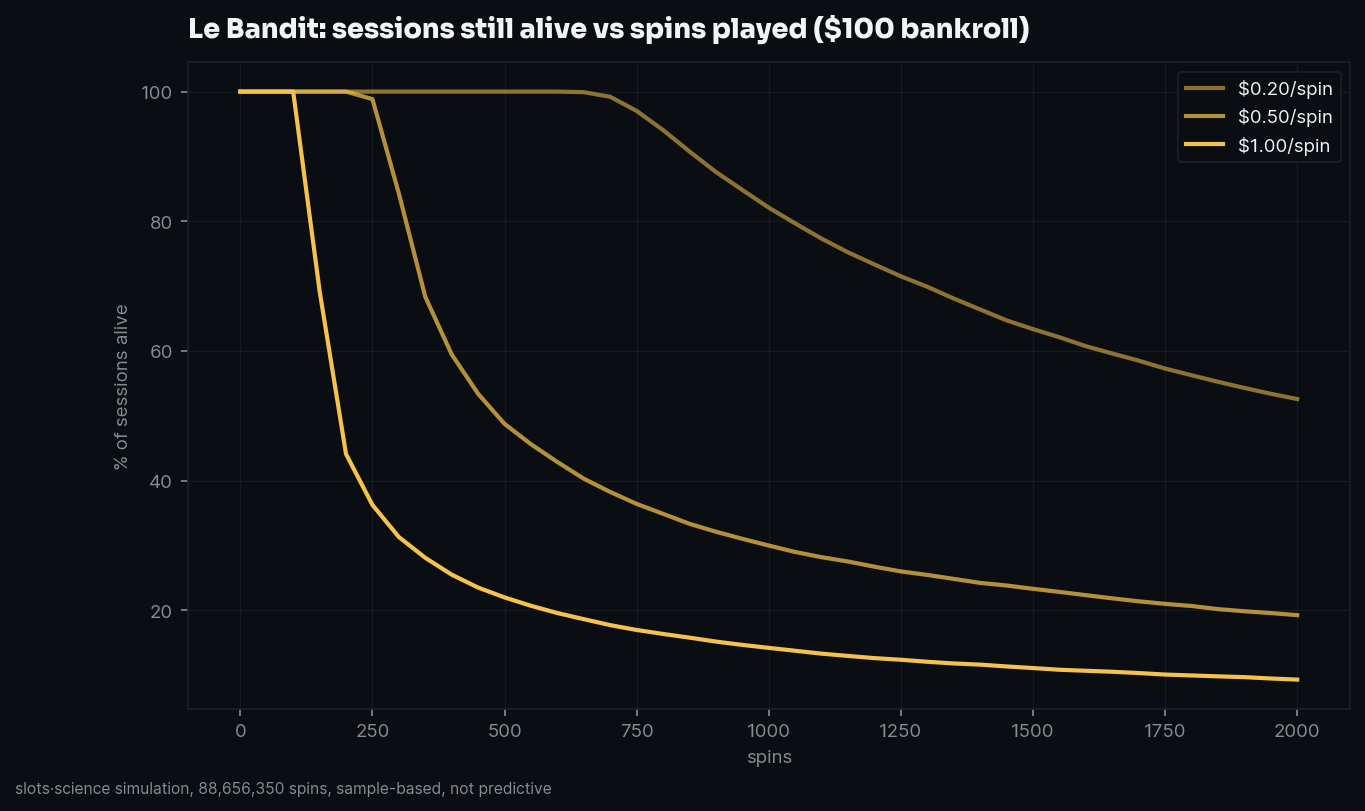
At a $100 bankroll, the median session lasted 2000 spins at $0.20 a spin, 484 spins at $0.50, and 181 spins at $1.00. Stake-to-bankroll cover, not the game, decided how long the money lasted: every step up in stake at a fixed bankroll shortened the session and raised the chance of busting.
bust rates
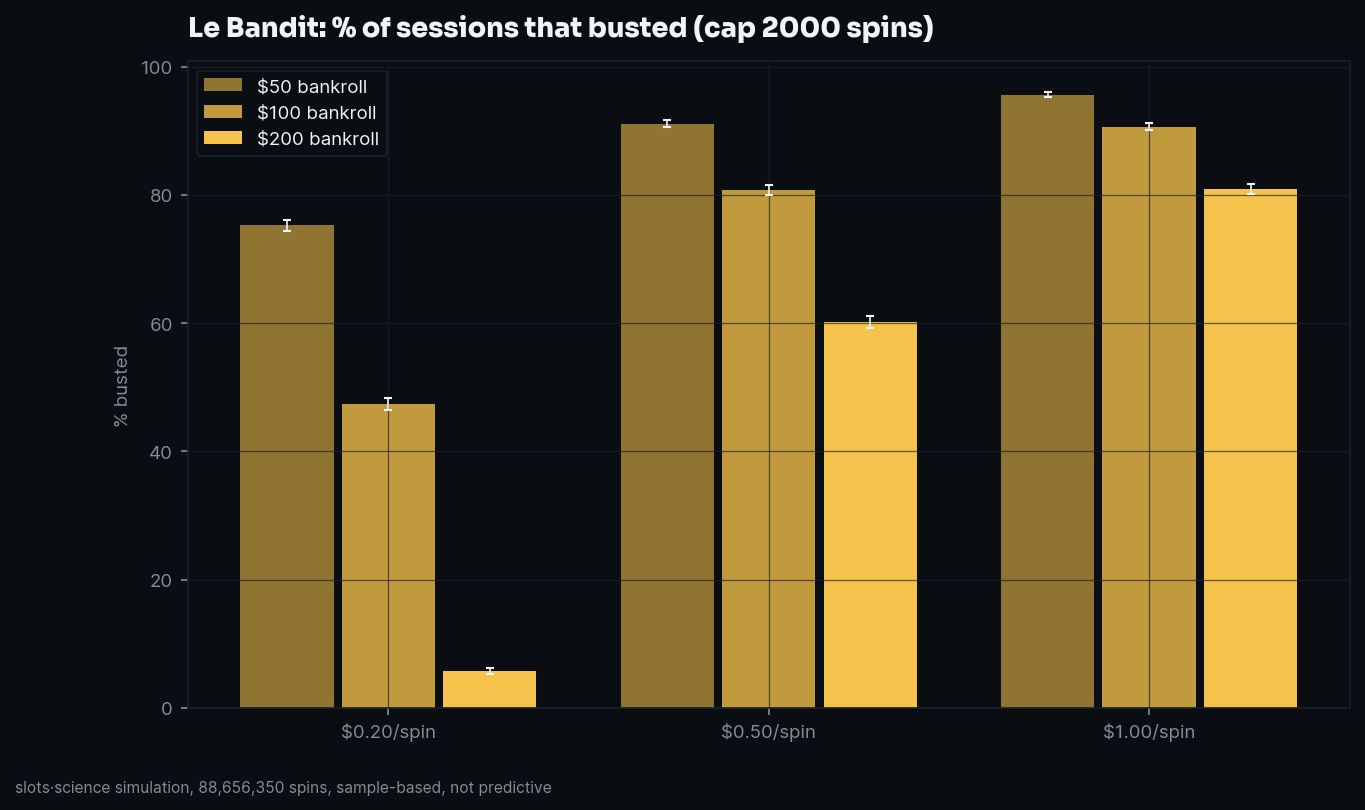
Share of sessions that busted before the 2,000-spin cap (default 96.34% version, 95% CI):
| $50 bankroll | $100 bankroll | $200 bankroll | |
|---|---|---|---|
| $0.20/spin | 75.3% ±0.9 | 47.4% ±1.0 | 5.8% ±0.5 |
| $0.50/spin | 91.1% ±0.6 | 80.7% ±0.8 | 60.2% ±1.0 |
| $1.00/spin | 95.7% ±0.4 | 90.7% ±0.6 | 81.0% ±0.8 |
what a finished session looks like
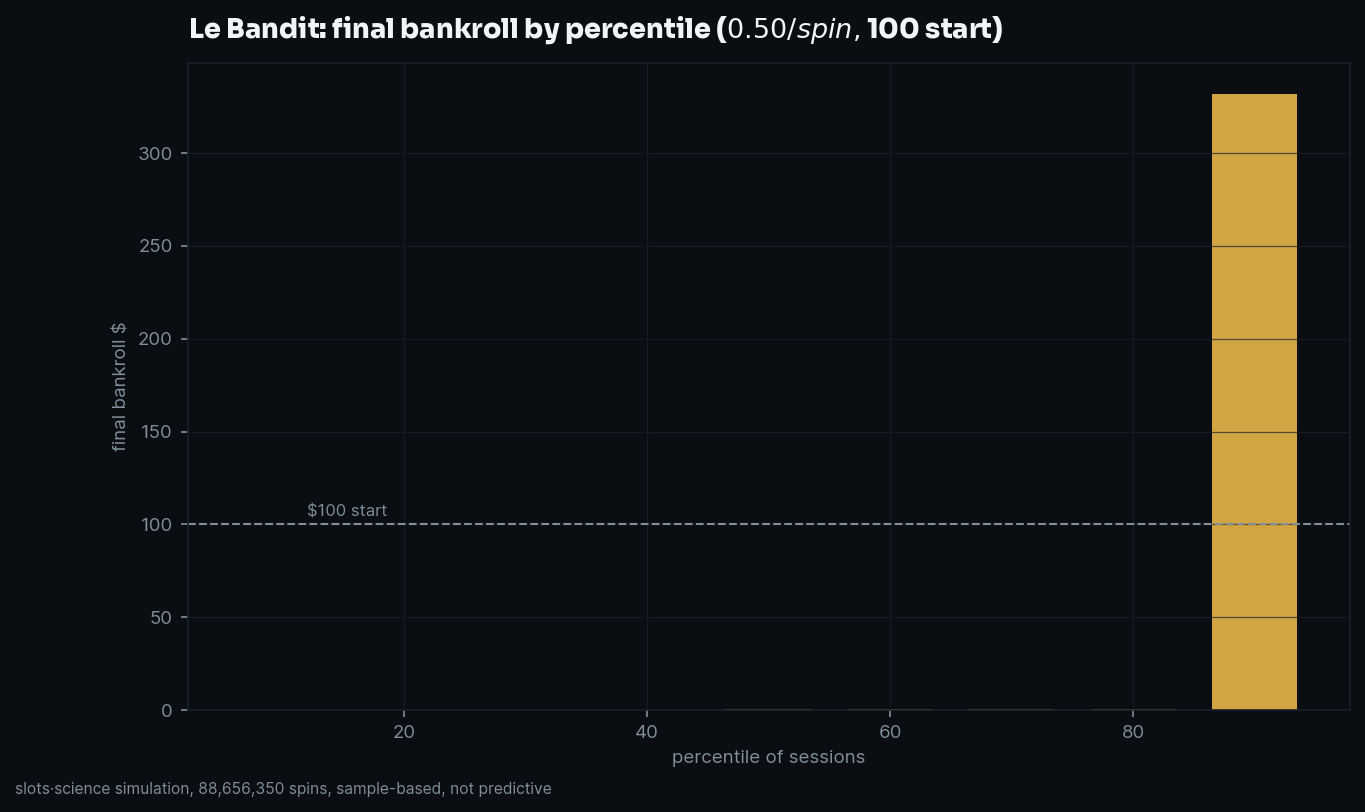
At $0.50 on a $100 bankroll the median session ended with $0.32 of the original $100. The 90th percentile kept $331.84. In our model a bonus arrived about once every 251 spins on average (a modelled trigger rate, flagged). This is the shape of a negative-expectation game: most sessions drain toward zero, a few tails run long, and the average is propped up by outcomes most players never see.
the rtp version lottery
The same game ships at different RTP versions and the casino chooses which to run. We re-ran the full grid at the 88.36% floor. Holding every other input constant, only the RTP changed:
| cell | 96.34% default | 88.36% floor | delta |
|---|---|---|---|
| $0.20 / $100 | 47.4% | 60.5% | +13.1pp |
| $0.50 / $100 | 80.7% | 86.7% | +6.0pp |
| $0.50 / $200 | 60.2% | 70.2% | +10.1pp |
| $1.00 / $200 | 81.0% | 86.5% | +5.6pp |
Same game, same animations, same bonus wait. The difference is which version the operator licensed, the one variable a player never sees on the reels. This is why we promote the casino running the highest published version: see the casinos ranked by verified RTP.
methodology note
We simulate models calibrated to published math (RTP, hit frequency, volatility class, bonus behaviour), not the provider's game engine. Results are sample-based observations from 167,783,284 simulated spins across two RTP calibrations, with 95% confidence intervals. Estimated (hacksaw does not publish a hit frequency; low-confidence). Bonus trigger rate and value are modelled estimates and flagged; the verified item is the four-step published RTP ladder. Slots are negative-expectation games; nothing here predicts outcomes or improves odds. Corrections policy: methodology.html.
Where the max win actually comes from
62% of this game's RTP is locked inside the bonus you rarely trigger; the base game on its own returns just 36%.
A normal spin in our simulation never returned more than ~100x (€50). The 10,000x top win is a feature event, it only came out of the bonus. (base-game ceiling: paytable-sourced)
Play the Le Bandit demo, or stress-test it
Looking for the Le Bandit demo or free play? A demo shows you a handful of spins. Our free simulator runs Le Bandit across thousands of sessions and shows what actually happens to a bankroll over time: the bust rate, how long the money lasts, and the wait for the bonus. It is the demo with the math switched on.
Every new study, as it publishes
No feed games: one Telegram digest with each study's headline numbers, the week it lands.
get the weekly digest on telegram
FAQ
What is the real RTP of Le Bandit?
The default published RTP we modelled is 96.34%. It also ships in lower published versions (ladder: 96.34%, 94.23%, 92.17%, 88.36%), and the casino, not the game, picks which one runs; check the RTP in the game's info panel.
Is Le Bandit a tight slot? How many sessions bust?
In our simulation at the default RTP, 80.7% of $0.50-a-spin sessions on a $100 bankroll busted before the 2,000-spin cap. That is a measured session cost across thousands of simulated sessions, not a prediction for your next one.
How often does the Le Bandit bonus hit?
About once every 248 spins on average in our simulation, roughly 50 minutes at five spins a minute. Real gaps vary widely around that average, and a bonus is never "due".
Is there a Le Bandit demo or free play?
Yes. You can play Le Bandit in demo mode at most casinos, and you can stress-test it free in our simulator, which runs thousands of sessions and reports the bust rate and session length, the demo with the math switched on.
Is Le Bandit worth playing?
It is negative-expectation like every slot. In our simulation, 80.7% of $0.50/$100 sessions busted before the 2,000-spin cap. We report the cost; we never tell you to play.
Related studies
- this slot’s bonus-buy study: what a Le Bandit feature buy actually returns
- Cash Crew
- Chaos Crew
- Chaos Crew 2
- the full RTP database, how often slots really pay, aggregated
- all 101 studies