
188.8 million spins on le king: "medium volatility" still busted 76.5% of $0.50/$100 sessions
exp · 007 · 2026-06-13 · simulation-based
last updated 2026-06-13
Run it yourself in the live simulator. All figures are simulation-based observations, not predictions. See our methodology.
what we measured
| parameter | value |
|---|---|
| simulated rtp versions | 96.14%, provider default (main sections) and 88.25%, the lowest published ladder step (version-lottery section). the full ladder is 96.14 / 94.18 / 92.25 / 88.25 |
| stakes | $0.20 / $0.50 / $1.00 per spin |
| bankrolls | $50 / $100 / $200 |
| sessions per combo | 10,000 (90,000 sessions per version; 98,975,101 spins at default, 89,781,826 at the floor) |
| spin cap | 2,000 spins per session |
| model | le-king-v1, medium volatility, 41.33% hit frequency (two-source third-party figure), 20,000x cap; bonus trigger and value derived from the published buy menu (see methodology) |
| bonus-buy module | all four buy modes at $0.50 stake: bonushunt 3x/spin (96.13%), shamrock & roll 60x/spin (96.31%), spin city 80x (96.31%), jackpot of gold 250x (96.36%), published per-buy rtps used as real model inputs; ~500,000-buy payout sample per mode |
the question: a medium-volatility label wrapped around an all-or-nothing 20,000x jackpot marker, what does that tail cost the ordinary session, and what do four buy prices spanning 3x to 250x actually change when their published rtps sit within 0.23 points of each other?
how long bankrolls survived
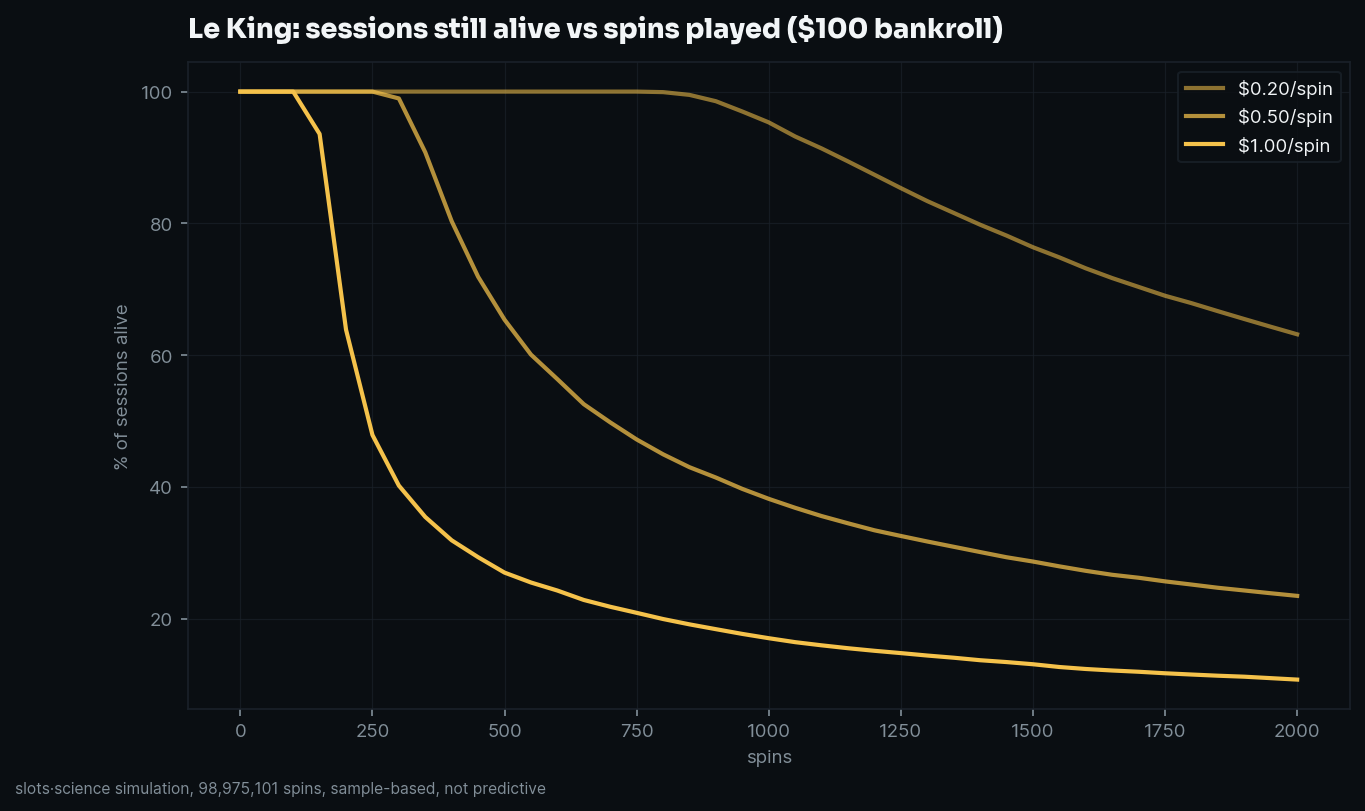
three observations from the $100-bankroll curves. at $1.00 a spin, the median session was dead by spin 239 and 89.2% busted before the cap. at $0.50, the median session lasted 696 spins, roughly two hours and twenty minutes at a normal pace, noticeably longer than the high-volatility hacksaw titles we've run on the same grid (wanted dead or a wild: 484 spins in exp 002). at $0.20 the median session was still alive at the 2,000-spin cap. the medium-volatility label buys playing time; it does not change where the time leads, the cells below say where.
bust rates
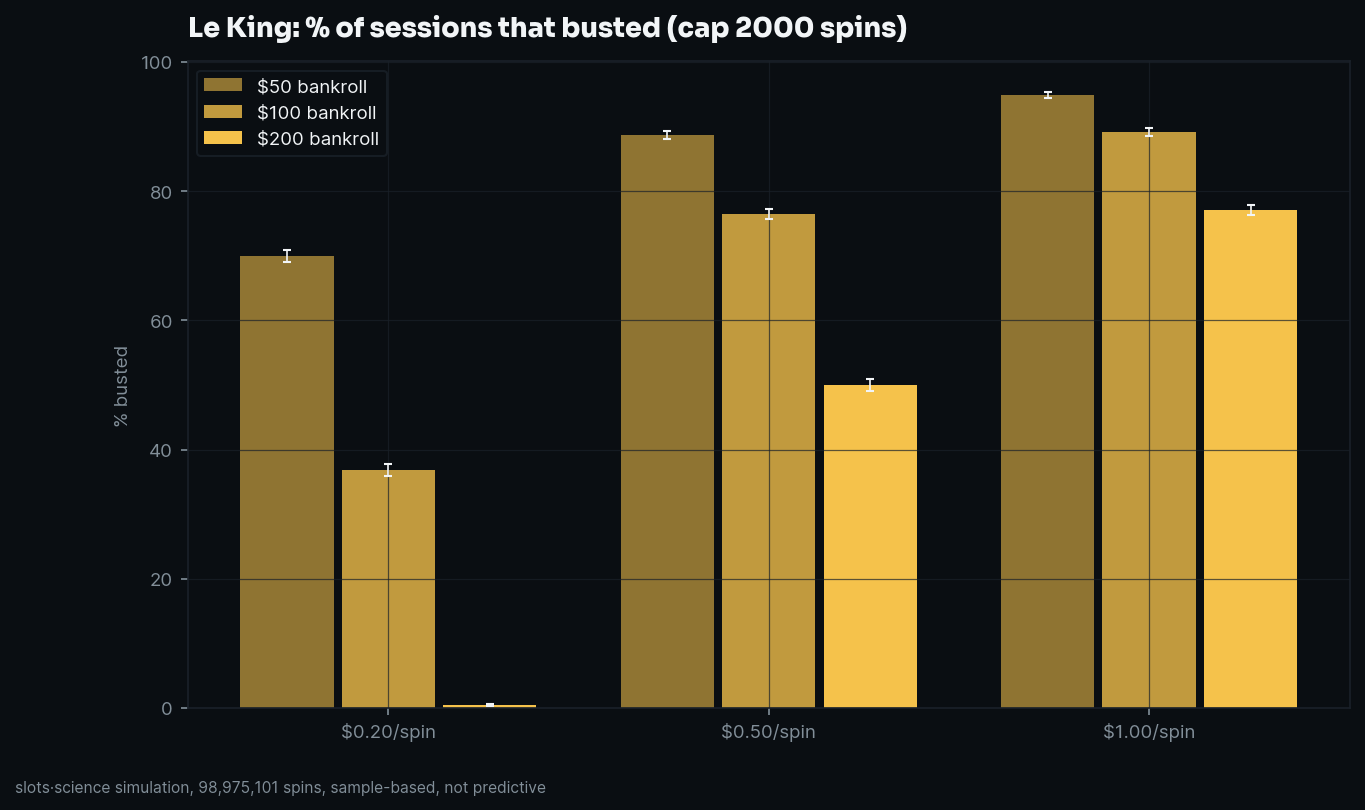
% of sessions that busted before the 2,000-spin cap (95% ci), 96.14% version:
| $50 bankroll | $100 bankroll | $200 bankroll | |
|---|---|---|---|
| $0.20/spin | 70.0% ±0.9 | 36.9% ±1.0 | 0.5% ±0.1 |
| $0.50/spin | 88.8% ±0.6 | 76.5% ±0.8 | 50.0% ±1.0 |
| $1.00/spin | 95.0% ±0.4 | 89.2% ±0.6 | 77.1% ±0.8 |
plain reading: cover decides everything. 1,000 spins of cover ($0.20/$200) busted one session in 200; 50 spins of cover ($1.00/$50) busted nineteen in twenty. and the medium-volatility discount is real but small, the $0.50/$100 cell busted 76.5% ±0.8 here against 81.3% ±0.8 for wanted dead or a wild (high volatility) on the identical grid: about five points of bust rate is what the softer label was worth, measured under our matching session protocol.
the bonus wait, and what it pays
hacksaw publishes no trigger rate for le king, but it publishes enough to derive one: the 3x-per-spin bonushunt mode multiplies the bonus chance by five and carries a 96.13% published rtp, which, assuming base pays are unchanged in that mode, pins the bonus layer's share of rtp at 50.0% and the combined natural trigger at about 1-in-243 spins (full derivation in the model file; this is a calibrated input, not a finding). the sample behaved accordingly: 407,024 triggers across the default grid, one per 243.2 spins.
what the triggers paid (model-based estimates, the distribution shape is a calibrated assumption): the mean bonus tracked its 116.8x calibration, but the median was 63.7x, half of all bonuses paid less than that, 14.6% paid under 20x, and 41.3% paid under 50x. the 99th percentile reached 824x, and the single largest natural bonus in 188.8 million spins paid 11,888x, the 20,000x cap was never hit naturally in sample. a caution our model is built to respect: the real game routes its extreme tail through discrete jackpot markers (10x / 100x / 1,000x / 20,000x) that only pay when a neon rainbow activates them, and our sample cannot resolve how often the 20,000x marker actually hits, we model the tail's weight, not the marker mechanic. the same applies to the 5-scatter viva le bandit bonus: not buyable, no published rtp, not separately resolvable.
the flip side of routing half the rtp through a 1-in-243 event is what's left over: at a 41.33% hit frequency, the base game's average hit is worth about 1.16x the stake (a model property, not a finding). the screen pays constantly, dead runs are short, with one session in ten at $0.50/$100 seeing a worst streak of 15+ spins and the longest dead run observed anywhere in 90,000 default sessions being 33 spins (a sample observation, not a distribution claim), while the bankroll quietly funds the tail.
what a finished session looks like
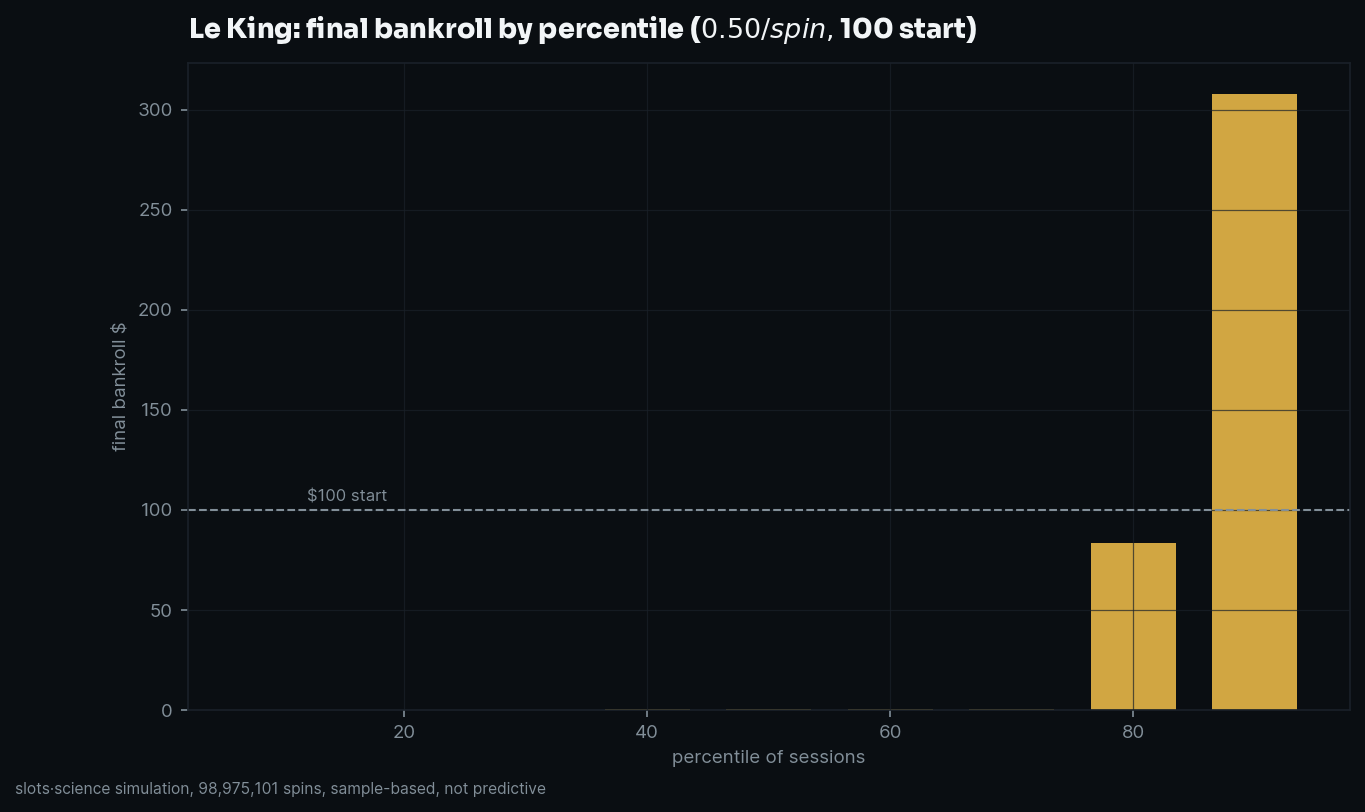
the $0.50/$100 cell, by percentile: half of all sessions ended below $0.35. seventy percent ended below $0.47, less than one spin. the 80th percentile kept $83.45 and the 90th kept $307.88. there is almost nothing in between busted and well ahead: the frequent small hits change the texture of a session, not its two destinations.
the bonus buy math
all four modes are directly purchasable (not in the uk market, outside our geos in any case). hacksaw publishes a per-mode rtp for every one of them, rare, and worth saying plainly: the buy rtps below are published figures used as real inputs, not assumptions (they are single-source, transcribed from the in-game panel by clash of slots, and take a minute to confirm on the demo info screen). the envelope is the first finding, and it's a property of the published math itself: four prices from 3x to 250x, all within 96.13-96.36%, a 0.23-point spread. the $1.50 bonushunt spin and the $125 jackpot of gold buy cost the player almost exactly the same per dollar wagered. what the price buys is variance, not expectation.
we simulated the obvious strategy at a $0.50 stake: buy, collect, buy again, until the next buy is unaffordable or the round cap (2,000 rounds for the per-spin bonushunt mode, matching the session grid; 500 for the rest). 10,000 sessions per cell. one modelling note up front: all four modes share a single payout-spread assumption, so the per-buy distribution rows differ only by price, and for the two featurespins modes that assumption is coarser than for the one-shot buys (a real bonushunt spin pays nothing most of the time and occasionally a full bonus; our continuous model smooths that), so lean on the bankroll rows for those, not the percentiles.
| mode | cost at $0.50 | bankroll (buys affordable) | couldn't rebuy (95% ci) | median buys survived | ever ahead | finished ahead | median final |
|---|---|---|---|---|---|---|---|
| bonushunt featurespins | $1.50/spin | $50 (33) | 90.1% ±0.6 | 418 | 88.9% | 8.0% | $1.09 |
| $100 (66) | 74.0% ±0.9 | 1,107 | 91.4% | 13.4% | $1.21 | ||
| $200 (133) | 34.2% ±0.9 | 2,000 (cap) | 92.5% | 15.2% | $72.61 | ||
| shamrock & roll featurespins | $30/spin | $50 (1) | 99.0% ±0.2 | 2 | 34.8% | 1.0% | $22.77 |
| $100 (3) | 97.2% ±0.3 | 8 | 54.5% | 2.7% | $20.97 | ||
| $200 (6) | 93.1% ±0.5 | 30 | 70.1% | 6.7% | $21.15 | ||
| spin city | $40 | $50 (1) | 99.4% ±0.2 | 1 | 28.8% | 0.6% | $22.50 |
| $100 (2) | 98.3% ±0.3 | 5 | 47.8% | 1.7% | $28.53 | ||
| $200 (5) | 95.0% ±0.4 | 18 | 65.6% | 4.9% | $28.08 | ||
| jackpot of gold | $125 | $125 (1) | 99.5% ±0.1 | 1 | 26.9% | 0.5% | $50.64 |
| $250 (2) | 98.9% ±0.2 | 3 | 43.3% | 1.1% | $79.69 | ||
| $625 (5) | 95.0% ±0.4 | 18 | 65.4% | 4.8% | $87.60 |
(jackpot of gold uses scaled bankrolls, the standard $50-$200 grid can't fund a $125 buy. "couldn't rebuy" is not busting to zero: the session ends when the next buy is unaffordable, usually with change left.)
the per-buy reality (model-based estimates; each mean tracks its published buy rtp by construction):
| mode | cost | median payout | paid less than cost | less than half cost | p90 | p99 | max observed |
|---|---|---|---|---|---|---|---|
| bonushunt | 3x | 1.4x | 73.7% | 52.2% | 6.5x | 22.7x | 535x |
| shamrock & roll | 60x | 28.1x | 73.6% | 52.1% | 130.8x | 455.8x | 10,726x |
| spin city | 80x | 37.5x | 73.6% | 52.1% | 174.4x | 607.6x | 14,301x |
| jackpot of gold | 250x | 117.3x | 73.6% | 52.1% | 545.5x | 1,899.5x | 20,000x (cap) |
two findings. first, price buys endurance, nothing else: with the published rtps this close, identical cover produces statistically identical outcomes regardless of price, the $200 bankroll buying spin city (5 buys of cover) and the $625 bankroll buying jackpot of gold (also 5 buys) returned the same numbers to within noise: 95.0% ±0.4 couldn't rebuy in both, median 18 buys in both, 4.9% vs 4.8% finished ahead. the mode doesn't matter; the ratio of bankroll to price does. second, the cheap mode's long leash changes the experience without changing the destination: $200 pointed at $1.50 bonushunt spins was ever-ahead at some point in 92.5% of sessions and ran a median 2,000 rounds, yet only 15.2% finished ahead. the gap between 92.5% ever-ahead and 15.2% finished-ahead is the signature of a strategy that never stops while it's winning. and roughly three buys in four lost money in every mode (under our shared spread assumption), at 3x and at 250x alike. the tail is the sales pitch: jackpot of gold reached the 20,000x cap in a ~500,000-buy sample; bonushunt's 99th-percentile spin paid 22.7x the stake, about 7.6 times its 3x price.
the rtp version lottery
everything above was simulated at 96.14%, the provider default and the ceiling. hacksaw also publishes le king at 94.18, 92.25 and 88.25: a 7.89-point spread, with bigwinboard describing 96.14 as the maximum and the lower settings as operator picks. no tracker currently documents which versions are deployed where (findmyrtp has no le king page yet, an open collection item), so we simulated the published floor rather than an observed deployed version, and we say so. the full nine-cell grid was re-run at 88.25%, 89.8 million spins, same validation gate, with hit rate, volatility and trigger rate held constant and the bonus value scaled proportionally (107.2x) to hold the 50/50 contribution split (stated assumption; hacksaw publishes variant rtps, not variant mechanics).
the $0.50/$100 cell, ceiling vs floor:
| version | bust rate (95% ci) | vs default | median session | median final | p90 final |
|---|---|---|---|---|---|
| 96.14 (default) | 76.5% ±0.8 | , | 696 spins | $0.35 | $307.88 |
| 88.25 (floor) | 84.3% ±0.7 | +7.8pp ±1.1 | 555 spins | $0.32 | $173.13 |
the floor was significantly worse in all nine cells. the biggest deltas landed where sessions run longest: $0.20/$100 went from 36.9% ±1.0 to 49.9% ±1.0 busted (+13.1pp ±1.4, a coin flip where the default version busted just over a third), and $0.50/$200 from 50.0% ±1.0 to 63.0% ±0.9 (+13.0pp ±1.4). the grid's safest cell ($0.20/$200) multiplied its bust rate by four, 0.5% ±0.1 to 2.2% ±0.3. as usual, the median final barely moves ($0.35 → $0.32) because the median session ends near zero at every version, what the floor takes is playing time (696 → 555 median spins) and the upside tail (90th-percentile finish nearly halved, $307.88 → $173.13). same raccoon, same neon, same 20,000x on the marketing sheet, the difference is which of four versions the operator licensed, and that's not shown on the reels.
methodology note
we simulate models calibrated to published math, rtp, hit frequency, volatility profile, bonus behavior, not the provider's game engine. results are sample-based observations from 188.8 million simulated session spins across two published rtp calibrations, plus roughly two million simulated feature buys (~500,000-buy payout samples per mode), with 95% confidence intervals shown. slots are negative-expectation games; nothing here predicts outcomes or improves odds. model and validation data: le-king-v1, analytic rtp exact at 96.14%, measured 95.75% over a 10-million-spin verification run (within sampling noise; heavy-tailed slots can't be measured tighter than ~0.4pp at that size); the 88.25% recalibration measured 87.89% over its own 10-million-spin check, also within noise. hacksaw publishes no natural trigger rate, so we derived one from the published buy menu: bonushunt's 3x price, 96.13% rtp and 5× trigger multiplier (base pays assumed unchanged) pin the bonus layer at 50.0% of rtp; the bonus value (116.8x) is anchored to the spin city and jackpot of gold buys (80×0.9631, 250×0.9636) with a trigger mix inversely proportional to buy price, full derivation in the model file. the four per-buy rtps (96.13 / 96.31 / 96.31 / 96.36) are published figures used as real inputs, single-sourced from the in-game panel via clash of slots and demo-verifiable. a single payout-spread assumption is applied to all four buy modes; the discrete jackpot-marker mechanic (10x/100x/1,000x/20,000x) is modelled as tail weight, not as markers, marker hit frequencies are not resolvable from this model and we make no claim about them. hit frequency (41.33%) is a two-source third-party figure. corrections policy: methodology.html.
Where the max win actually comes from
50% of this game's RTP is locked inside the bonus you rarely trigger; the base game on its own returns just 48%.
A normal spin in our simulation never returned more than ~25x (€12). The 20,000x top win is a feature event, it only came out of the bonus. (base-game ceiling: paytable-sourced)
Play the Le King demo, or stress-test it
Looking for the Le King demo or free play? A demo shows you a handful of spins. Our free simulator runs Le King across thousands of sessions and shows what actually happens to a bankroll over time: the bust rate, how long the money lasts, and the wait for the bonus. It is the demo with the math switched on.
Every new study, as it publishes
No feed games: one Telegram digest with each study's headline numbers, the week it lands.
get the weekly digest on telegram
FAQ
What is the real RTP of Le King?
The default published RTP we modelled is 96.14%. It also ships in lower published versions (ladder: 96.14%, 94.18%, 92.25%, 88.25%), and the casino, not the game, picks which one runs; check the RTP in the game's info panel.
Is Le King a tight slot? How many sessions bust?
In our simulation at the default RTP, 76.5% of $0.50-a-spin sessions on a $100 bankroll busted before the 2,000-spin cap. That is a measured session cost across thousands of simulated sessions, not a prediction for your next one.
How often does the Le King bonus hit?
About once every 241 spins on average in our simulation, roughly 48 minutes at five spins a minute. Real gaps vary widely around that average, and a bonus is never "due".
Is there a Le King demo or free play?
Yes. You can play Le King in demo mode at most casinos, and you can stress-test it free in our simulator, which runs thousands of sessions and reports the bust rate and session length, the demo with the math switched on.
Is Le King worth playing?
It is negative-expectation like every slot. In our simulation, 76.5% of $0.50/$100 sessions busted before the 2,000-spin cap. We report the cost; we never tell you to play.
Related studies
- this slot’s bonus-buy study: what a Le King feature buy actually returns
- Cash Crew
- Chaos Crew
- Chaos Crew 2
- the full RTP database, how often slots really pay, aggregated
- all 101 studies