
173 million spins on sugar rush: it pays a win almost every third spin and still busted 82% of $0.50/$100 sessions
exp · 046 · 2026-06-27 · simulation-based
last updated 2026-06-27
Run it yourself in the live simulator. All figures are simulation-based observations, not predictions. See our methodology.
what we measured
| parameter | value |
|---|---|
| provider / engine | Pragmatic Play · 7×7 cluster pays, tumbling reels, no wilds |
| configs simulated | 96.50% (provider default) · 94.50% (floor of the published ladder) |
| published rtp ladder | 96.50% / 95.50% / 94.50%, a verified 2.00pp spread the casino selects |
| volatility | high (5/5) |
| hit frequency | 34.48% (a returning win about 1 in 2.9 spins) |
| max win | 5,000x stake (published probability 1 in 2,340,000 spins) |
| stakes | $0.20 / $0.50 / $1.00 per spin |
| bankrolls | $50 / $100 / $200 |
| sessions | 10,000 per stake/bankroll cell, 90,000 per version |
| spin cap | 2,000 spins per session |
model inputs worth flagging: RTP (96.50%, three sources including Pragmatic's own page), the full ladder, hit frequency (34.48%), max win (5,000x) and free-spins trigger rate (1 in 323) are sourced; the bonus payout distribution and the base-versus-feature RTP split are model assumptions (lognormal calibrated to the published RTP and the 5,000x cap), so all bonus-value figures are model-based estimates. the base-game ceiling (500x) is a reasoned estimate, the 5,000x max is realistically a free-spins event because the multiplier spots reset every paid base spin.
how long bankrolls survived
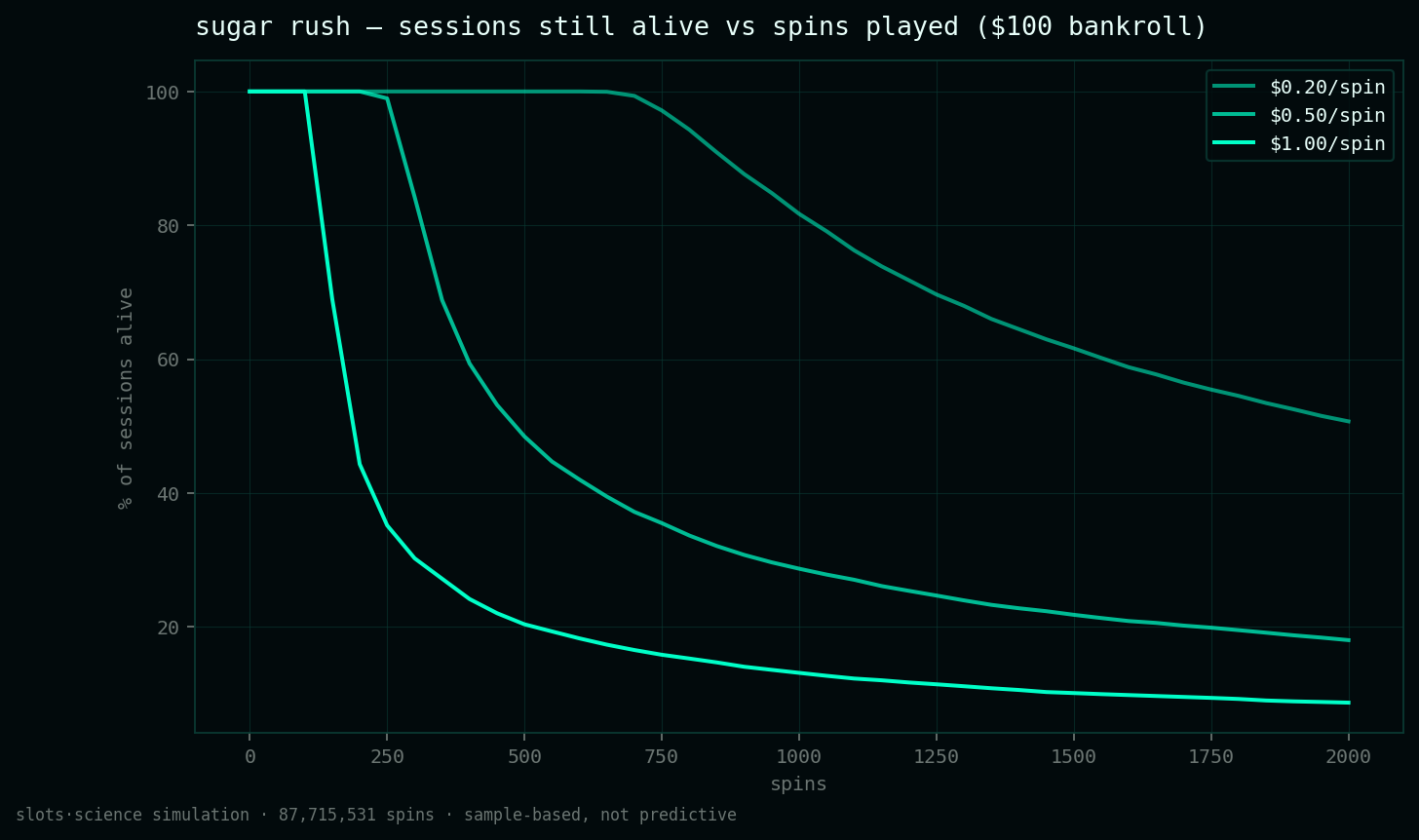
the stake sets the clock. at the $100 bankroll on the default version, the median session lasted 481 spins at $0.50 and far longer at $0.20. the high hit rate stretches sessions out, money keeps coming back in small amounts, but it does not change the destination: $0.50 against $50 busted 91.3% of the time, and even $1.00 against a deep $200 bankroll busted 81.4%.
bust rates
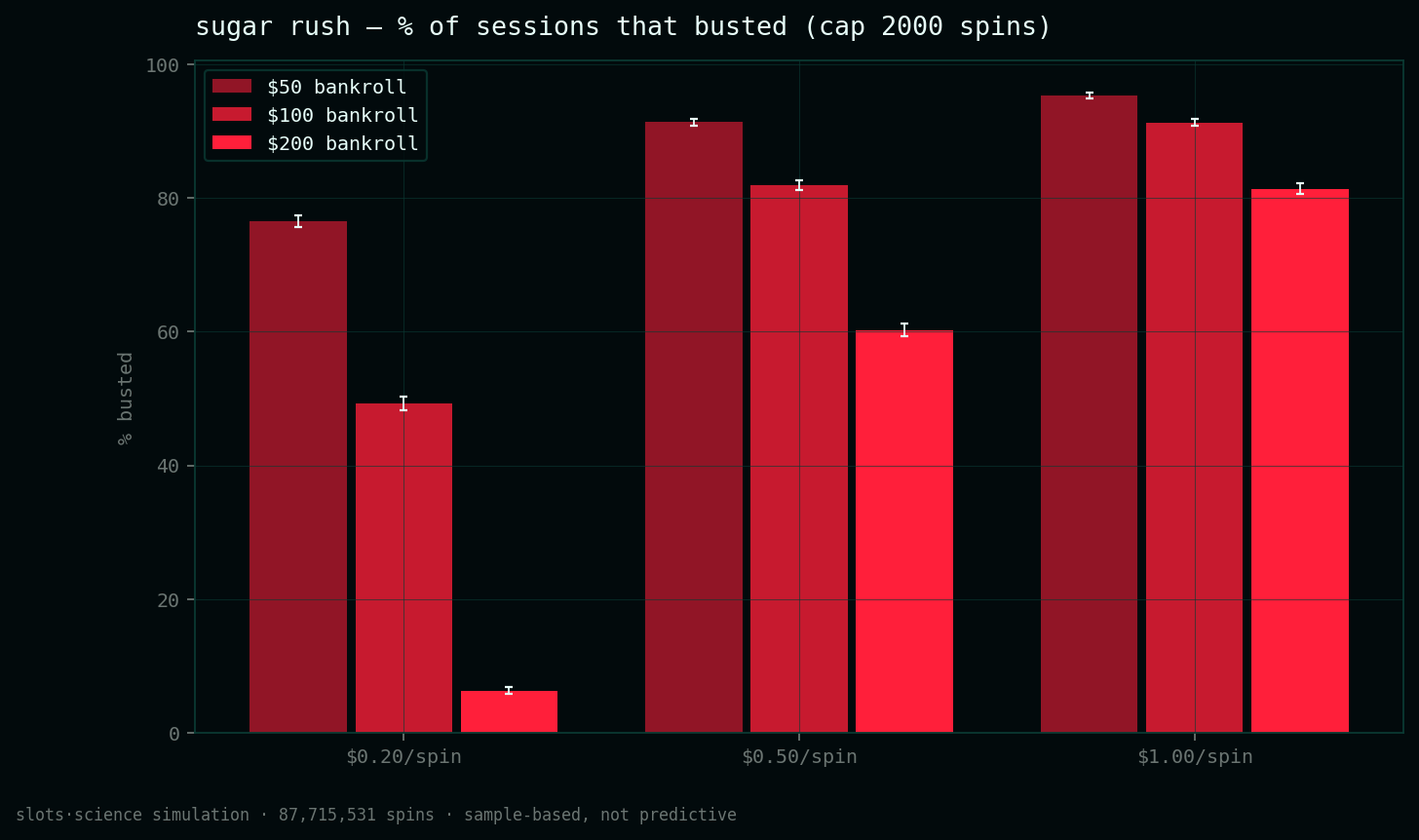
bust rates within the 2,000-spin cap, default 96.50% version, 95% confidence intervals:
| $50 bankroll | $100 | $200 | |
|---|---|---|---|
| $0.20/spin | 76.5% ±0.8 | 49.3% ±1.0 | 6.4% ±0.5 |
| $0.50/spin | 91.3% ±0.5 | 82.0% ±0.8 | 60.2% ±1.0 |
| $1.00/spin | 95.3% ±0.4 | 91.3% ±0.5 | 81.4% ±0.8 |
plain reading: a game that pays this often still empties most bankrolls. hold the bankroll at $100 and move the stake from $0.20 to $0.50 and the bust rate jumps from 49.3% to 82.0%, the biggest lever in the grid. the only comfortable cell is $0.20 against $200 (6.4%). dead streaks were shorter than on classic line games, at $0.50/$100 the 90th-percentile worst winless run was 18 spins, which is exactly why the bleed is easy to miss: you rarely go long without something landing, but the somethings are too small to matter.
the bonus wait, and what it pays
the free-spins round triggered about once every 324 spins, matching the published 1-in-323 rate. the payout side (model-based estimates, pooled over the simulated bonuses): the average bonus paid 179x stake, but the median was 97x, half of all bonuses paid less than that, and 27% paid under 50x. the round is where sugar rush keeps the bulk of its return: the persistent multiplier spots only build up across free spins, so a session that never triggers the feature is a session that only ever saw the lean base game. at $0.50 a spin a 1-in-324 trigger means a typical $100 bankroll buys roughly enough spins to expect a couple of bonuses, and most sessions that busted simply ran out before a paying one arrived.
what a finished session looks like
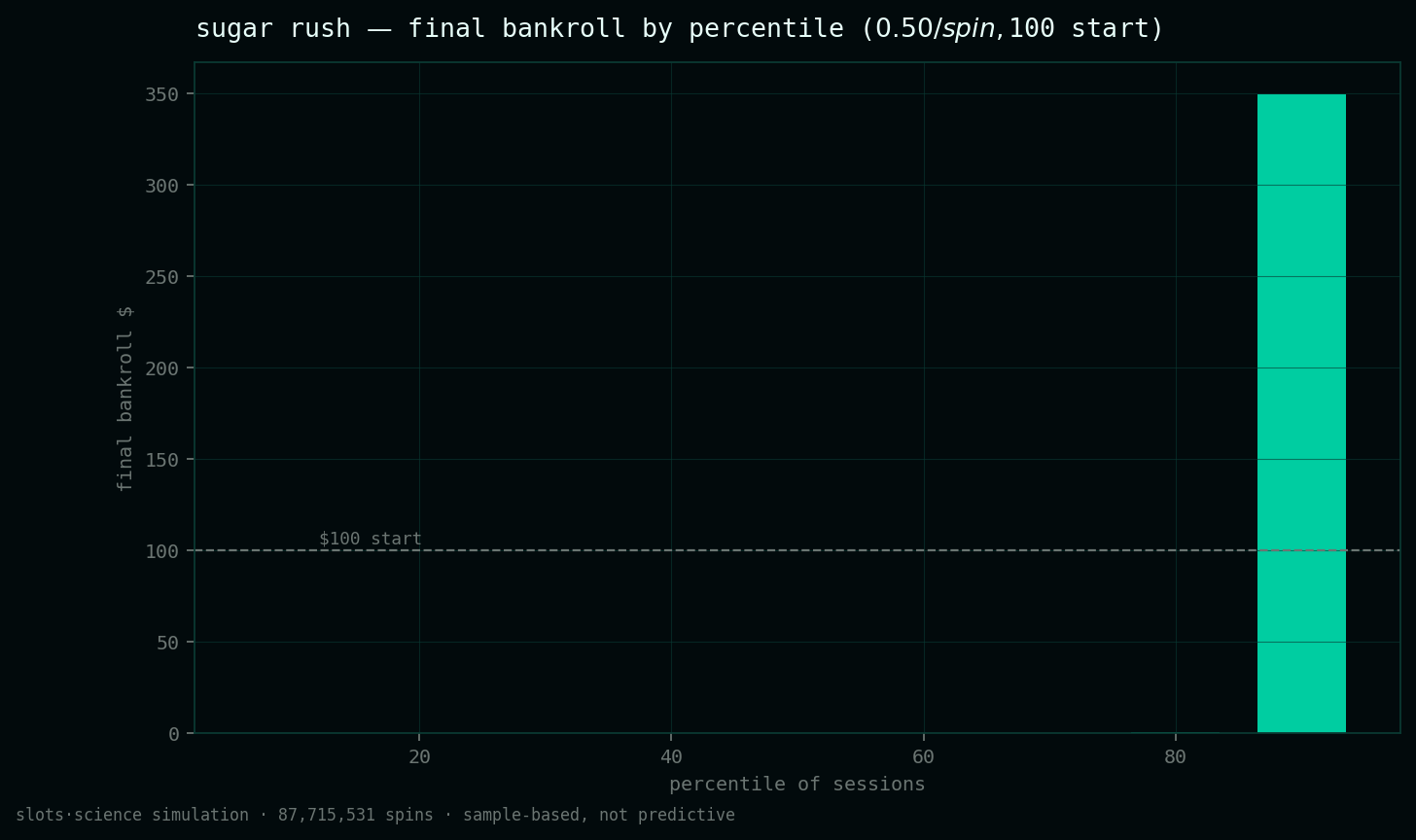
the final-bankroll distribution at $0.50/$100 (default version) has almost no middle. eight sessions in ten ended with under $0.50 of the original $100, busted, in effect, with the median finish near $0.43. then it leaps: the 90th percentile kept $349. like every high-volatility tumble game we have studied, sugar rush sessions overwhelmingly either die or, rarely, run hot; the steady-as-she-goes outcome barely exists despite the high hit rate.
the rtp version lottery
sugar rush ships at 96.50% and the casino can run it at 95.50% or 94.50% instead, a published 2.00pp spread (house edge 3.50% rising to 5.50%) that the player never sees on the reels. we ran the full grid at the 94.50% floor as well; same model, same inputs, only the RTP changed:
| cell | 96.50% default | 94.50% floor | delta |
|---|---|---|---|
| $0.20/$100 bust | 49.3% ±1.0 | 51.9% ±1.0 | +2.6pp |
| $0.50/$100 bust | 82.0% ±0.8 | 82.8% ±0.7 | +0.8pp |
| $0.50/$200 bust | 60.2% ±1.0 | 63.5% ±0.9 | +3.3pp |
| $1.00/$200 bust | 81.4% ±0.8 | 83.5% ±0.7 | +2.1pp |
| $0.20/$200 bust | 6.4% ±0.5 | 8.5% ±0.5 | +2.1pp |
the floor version raised the bust rate in every cell measured. the effect is smaller than on a 12-point ladder like Rise of Olympus, because the spread here is only two points, but it runs the same direction every time, and it is free money for whichever operator chooses to run it. the takeaway is the one that holds across our whole library: the version is the one variable a player can actually choose, so play it where the published RTP is highest. our casino hub ranks operators by exactly that.
methodology note
we simulate models calibrated to published math, RTP, hit frequency, volatility profile, bonus behaviour, not the provider's game engine. results are sample-based observations from 172,889,000 simulated spins (180,000 sessions across two RTP versions), with 95% confidence intervals shown. the bonus payout distribution and the base-versus-feature RTP split are modelled assumptions, so bonus-value figures are estimates; the base-game ceiling (500x) is a reasoned estimate. casino-by-casino RTP figures are the published ladder, not statements about any operator's current configuration. model validation: sugar-rush v1, analytic calibration exact at 96.50%, 10M-spin check measured 96.30% (within tolerance); floor config exact at 94.50%. slots are negative-expectation games; nothing here predicts outcomes or improves odds. corrections policy: methodology.html.
Where the max win actually comes from
57% of this game's RTP is locked inside the bonus you rarely trigger; the base game on its own returns just 41%.
A normal spin in our simulation never returned more than ~500x (€250). The 5,000x top win is a feature event, it only came out of the bonus. (base-game ceiling: model estimate)
Play the Sugar Rush demo, or stress-test it
Looking for the Sugar Rush demo or free play? A demo shows you a handful of spins. Our free simulator runs Sugar Rush across thousands of sessions and shows what actually happens to a bankroll over time: the bust rate, how long the money lasts, and the wait for the bonus. It is the demo with the math switched on.
Where Sugar Rush runs at the top version
Stake was among the casinos our 2026-07-03 version scan confirmed running the 96.50% version of Sugar Rush, the highest published, and it was not the only one: the scan confirmed several operators on the top version. A sighting is a dated observation, not a guarantee: versions move, so check the RTP in the game’s info panel on the day you play. A higher version returns more of what you stake on average; the game stays negative-expectation either way.
read our Stake review visit Stake
Every new study, as it publishes
No feed games: one Telegram digest with each study's headline numbers, the week it lands.
get the weekly digest on telegram
FAQ
What is the real RTP of Sugar Rush?
The default published RTP we modelled is 96.50%. It also ships in lower published versions (ladder: 96.50%, 95.50%, 94.50%), and the casino, not the game, picks which one runs; check the RTP in the game's info panel.
Is Sugar Rush a tight slot? How many sessions bust?
In our simulation at the default RTP, 82.0% of $0.50-a-spin sessions on a $100 bankroll busted before the 2,000-spin cap. That is a measured session cost across thousands of simulated sessions, not a prediction for your next one.
How often does the Sugar Rush bonus hit?
About once every 323 spins on average in our simulation, roughly 65 minutes at five spins a minute. Real gaps vary widely around that average, and a bonus is never "due".
Is there a Sugar Rush demo or free play?
Yes. You can play Sugar Rush in demo mode at most casinos, and you can stress-test it free in our simulator, which runs thousands of sessions and reports the bust rate and session length, the demo with the math switched on.
Is Sugar Rush worth playing?
It is negative-expectation like every slot. In our simulation, 82.0% of $0.50/$100 sessions busted before the 2,000-spin cap. We report the cost; we never tell you to play.
Which casino has the highest RTP for Sugar Rush?
Stake was among the casinos our 2026-07-03 version scan confirmed running the highest published version (96.50%), and it was not the only one: the scan confirmed several operators on the top version. A sighting is a dated observation, not a guarantee; check the game's info panel on the day you play.