
406 million spins on gates of olympus: twice the bonus frequency, zero of nine bankroll cells improved
exp · 003 · 2026-06-12 · simulation-based
last updated 2026-06-12
Run it yourself in the live simulator. All figures are simulation-based observations, not predictions. See our methodology.
what we measured
| parameter | value |
|---|---|
| simulated rtp version | 96.50%, provider default. the game also ships at 95.51 / 94.50 (a shallow 2.00pp ladder; deployment is bimodal, see "the rtp version lottery"). variant grids re-run at both |
| stakes | $0.20 / $0.50 / $1.00 per spin |
| bankrolls | $50 / $100 / $200 |
| sessions per combo | 10,000 (90,000 sessions, 104,202,069 spins on the primary grid) |
| spin cap | 2,000 spins per session |
| model | gates-v1, extreme volatility (5/5), 28.8% hit frequency (third-party figure; pragmatic doesn't publish one), 5,000x cap, bonus value derived from the 100x buy price (see methodology) |
| trigger-rate sensitivity | full grid re-run at the disputed 1-in-224 reading (98,422,861 spins), see "the bonus wait" |
| rtp-variant grids | full grid re-run at 95.51 and 94.50 (203,914,489 spins combined); 406,539,419 grid spins total across the four calibrations |
| bonus-buy module | 100x buy at $0.50 stake ($50/buy), $50/$100/$200 bankrolls, 10,000 sessions per bank, 500-buy cap; run at the 96.50% and 94.50% buy returns (1,002,090 simulated buys) |
the question: at the version most casinos actually run, how long do bankrolls survive a 5/5-volatility scatter-pays game, and does the unresolved bonus-trigger dispute change the answer?
how long bankrolls survived
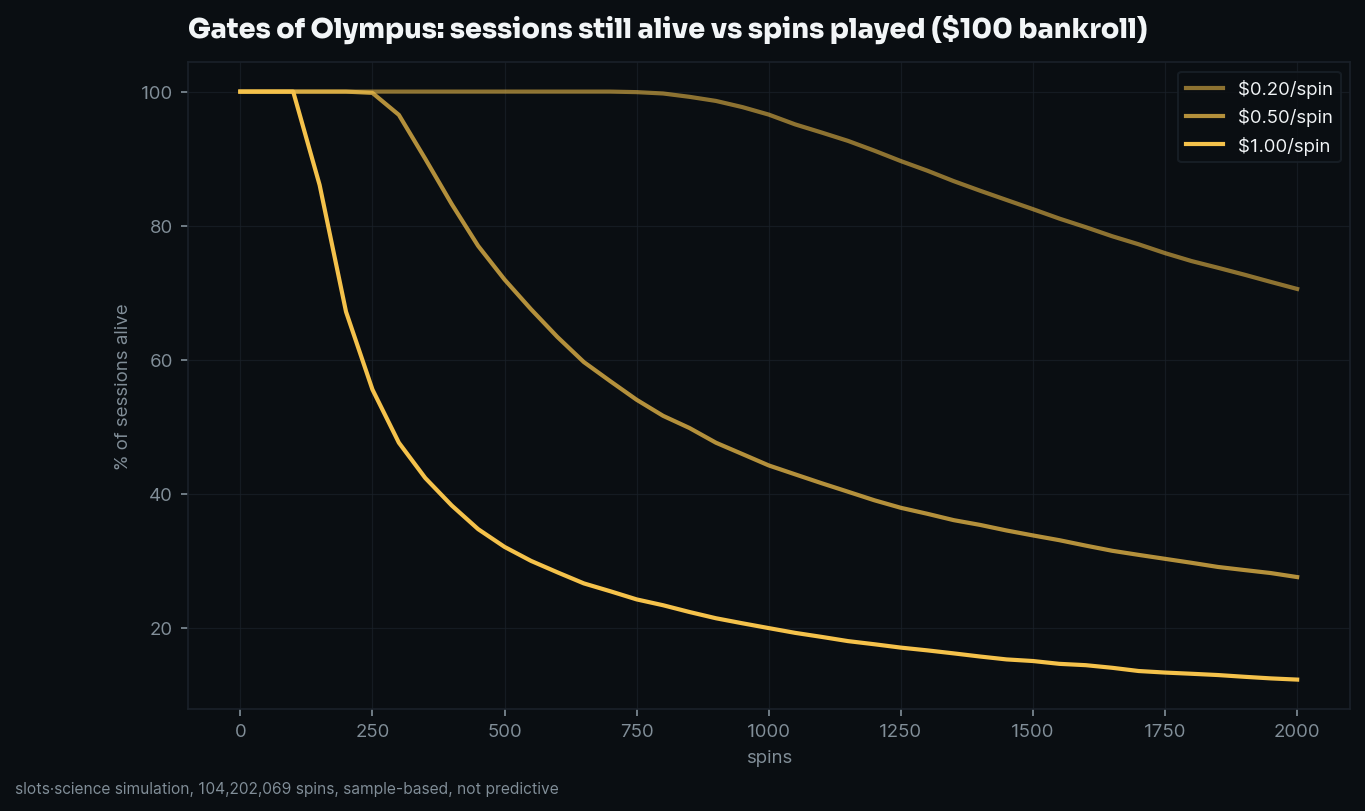
three observations from the $100-bankroll curves. at $1.00 a spin, half of all sessions were dead by spin 300 (median 283 spins) and only 12.3% reached the cap. at $0.50, the median session lasted 845 spins, nearly three hours at a relaxed ~5 spins a minute, before the same slow bleed took the rest; 27.6% were still alive at the cap. at $0.20, the median $100 session was still alive at 2,000 spins. as in our previous studies, stake-to-bankroll cover decided almost everything: the same game supports a multi-hour session or a 100-spin one depending only on the bet slider.
bust rates
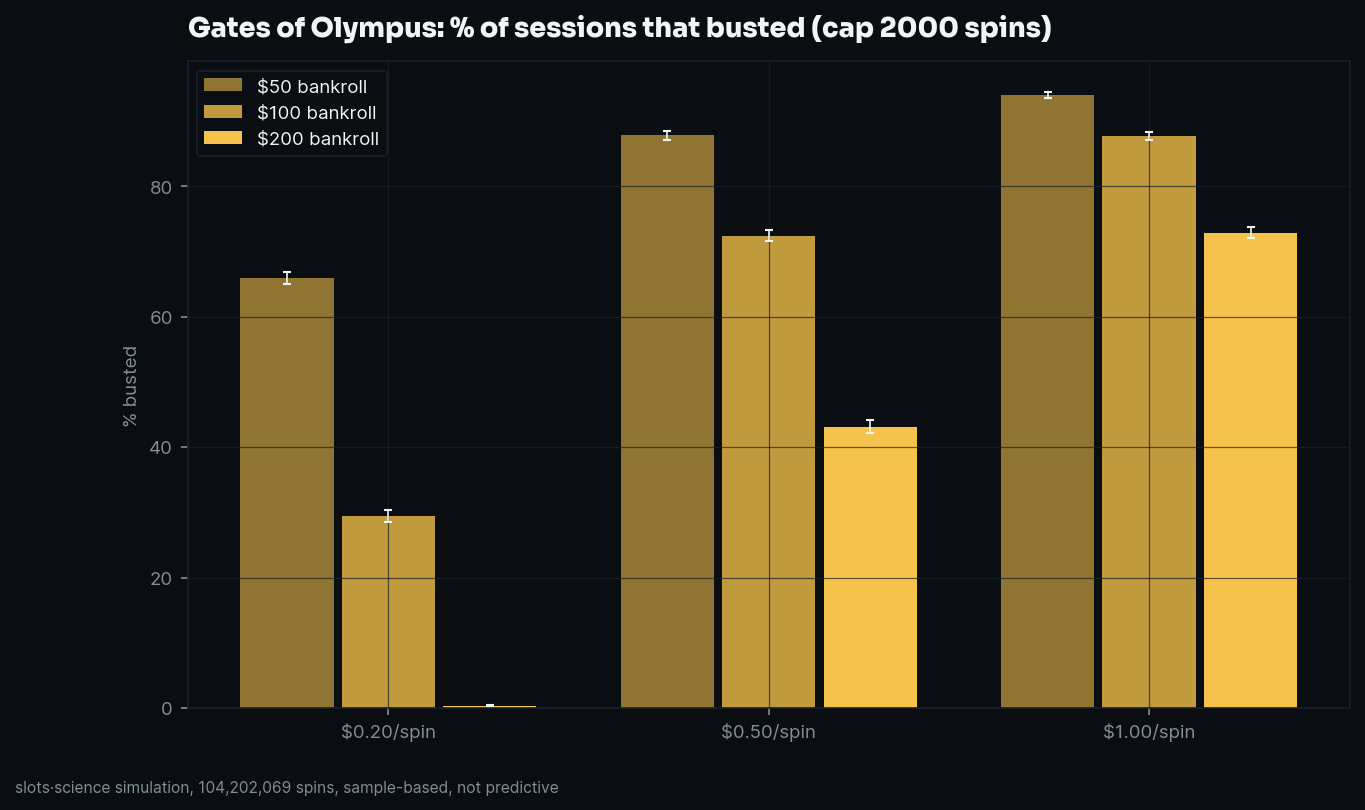
% of sessions that busted before the 2,000-spin cap (95% CI), primary model:
| $50 bankroll | $100 bankroll | $200 bankroll | |
|---|---|---|---|
| $0.20/spin | 66.0% ±0.9 | 29.5% ±0.9 | 0.4% ±0.1 |
| $0.50/spin | 87.8% ±0.6 | 72.4% ±0.9 | 43.1% ±1.0 |
| $1.00/spin | 94.0% ±0.5 | 87.7% ±0.6 | 72.9% ±0.9 |
plain reading: each step up in stake at a fixed bankroll cost between 6 points and 43 points of bust rate. the only cell that reliably survived was 1,000 spins of cover ($0.20 against $200) at 0.4%, the deepest-cover survival we've simulated to date, and this 5/5-volatility game still took 0.4% of sessions to zero there. $1.00 against $50 busted 94 times in 100.
the bonus wait, and what it pays
the spec flagged the trigger rate as this experiment's measurement target: the large-sample tracker says the free spins hit once in 447.6 spins (4.29 million real rounds), aggregator guides claim once in 209.4, and the likely explanation is the ante bet, which doubles trigger odds, putting the ante-on rate near 1-in-224, right where the aggregator number sits. our primary model uses 1-in-448 (the only large-sample figure, and a conservative natural-rate estimate, since any ante players mixed into that tracker sample could only have made its observed rate more frequent). the full grid was then re-run at 1-in-224 to bracket the dispute.
the 1-in-209 vs 1-in-448 dispute, measured
doubling the trigger frequency, with rtp held at 96.50%, improved zero of the nine cells. six got significantly worse, three moved within noise, none moved down:
| cell | bust @ 1-in-448 | bust @ 1-in-224 | delta |
|---|---|---|---|
| $0.20/$100 | 29.5% ±0.9 | 35.8% ±0.9 | +6.3pp ±1.3 |
| $0.50/$200 | 43.1% ±1.0 | 49.3% ±1.0 | +6.2pp ±1.4 |
| $0.50/$100 | 72.4% ±0.9 | 76.2% ±0.8 | +3.8pp ±1.2 |
| $1.00/$200 | 72.9% ±0.9 | 76.1% ±0.8 | +3.2pp ±1.2 |
| $0.20/$50 | 66.0% ±0.9 | 68.5% ±0.9 | +2.5pp ±1.3 |
| $0.20/$200 | 0.4% ±0.1 | 1.2% ±0.2 | +0.9pp ±0.3 |
| $0.50/$50, $1.00/$50, $1.00/$100 | , | , | within noise |
the mechanism is arithmetic, not mystery: the bonus is worth ~96.5x on average (see below), so at 1-in-448 it carries about 21.6 points of the game's 96.50% rtp; at 1-in-224 it carries about 43.1 points, and the base game must shrink from a 2.60x average hit to 1.86x to compensate. more of the return gets parked in rare events, sessions get swingier, and the median $0.50/$100 session shortens from 845 to 663 spins. this is a property of any fixed-rtp game, and it's worth stating because the 209-vs-448 argument is usually conducted as if the faster rate were obviously the better game. in our model it is not, it's the same expected return on a streakier schedule. (caveat: both runs hold hit frequency constant and neither models the ante bet's +25% stake surcharge; this brackets the trigger uncertainty, it does not simulate ante play.)
what the bonus paid
waits first, framed honestly as model inputs: at the tracker-derived 1-in-448 the average wait costs about $90 at $0.20 a spin and $448 at $1.00; under the model's geometric trigger process roughly a third of bonus-to-bonus gaps run past 500 spins and one in nine past 1,000. at the 1-in-224 reading, halve all of that.
payouts are where the model has something to say (233,474 simulated natural triggers, distribution shape model-based, see methodology). the mean bonus paid 96.5x, that's the model input, derived from the buy price. the finding is the shape around it: the median bonus paid 52.9x, barely half the mean. 18.8% of bonuses paid under 20x, 48.0% under 50x, and the 99th percentile paid 678x. the 5,000x cap was hit in sample. a feature whose typical outcome is half its average is what 5/5 volatility means in practice: the average is propped up by tails most sessions never see.
what a finished session looks like
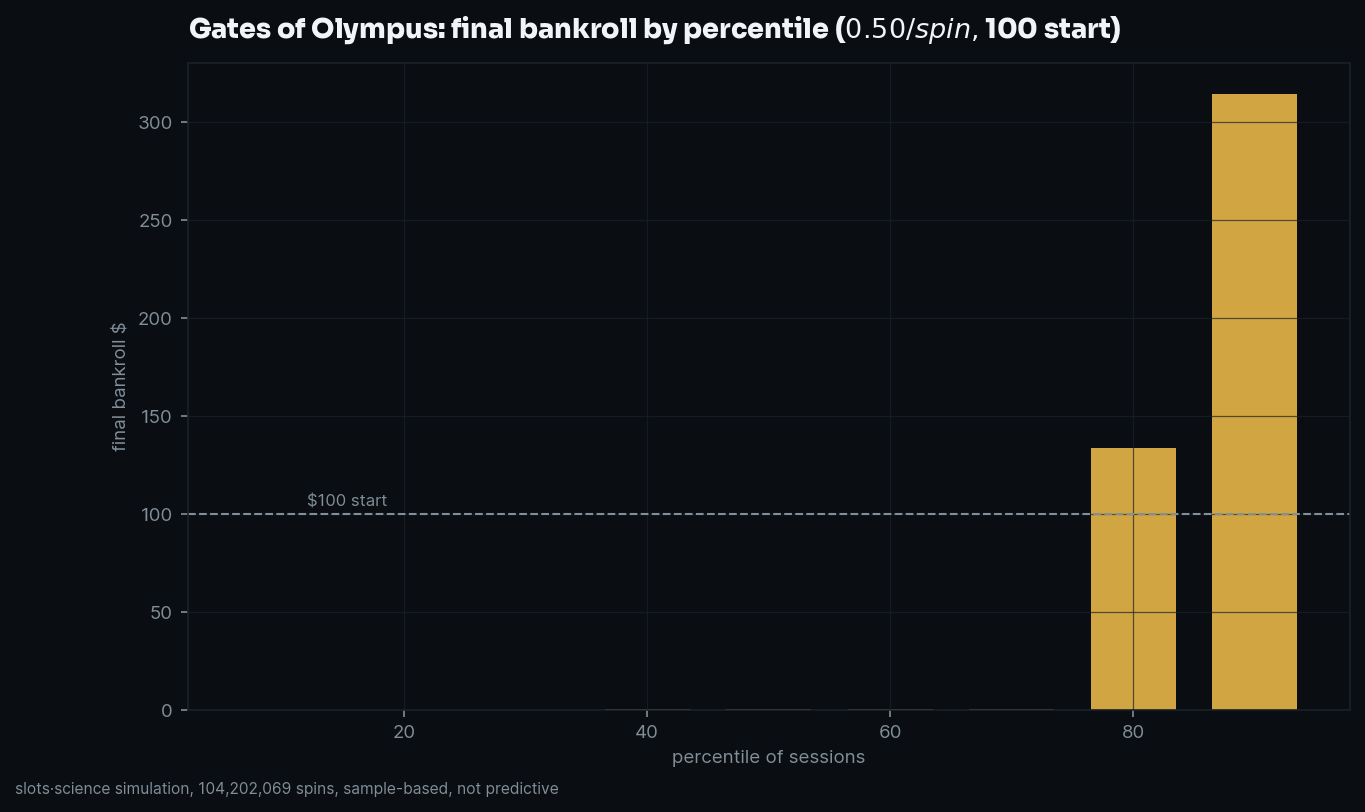
the $0.50/$100 cell, by percentile: half of all sessions ended below $0.36. seventy percent ended below $0.49, less than one spin. then the distribution jumps: the 80th percentile kept $133.75 and the 90th $314.26. there is almost no middle, sessions ended dead or they ended ahead, with very little in between. the dead streaks on the way are milder than the bust rates might suggest (28.8% of spins pay something): one session in ten at $0.50/$100 saw a run of 23 or more consecutive dead spins, and the longest dead run anywhere in 90,000 primary-grid sessions was 49 (a sample observation, not a distribution claim). this game doesn't starve you between wins, it pays small and often while the balance walks downhill.
the bonus buy math
the free spins are purchasable at 100x the bet (not in the uk, outside our geos in any case), and the buy carries no price premium: the published buy return equals the game's rtp. that is itself worth a paragraph: hacksaw-style buys typically run slightly above base rtp, so gates of olympus charges you exactly the game's long-run rate for skipping the wait, a fair-by-rtp ticket onto the same negative-expectation ride. we simulated the obvious strategy at a $0.50 stake ($50 per buy): buy, collect, buy again, until the bankroll can't fund the next buy or 500 buys pass. 10,000 sessions per bankroll, at both the default and floor rtp configs.
| buy return | bankroll (buys affordable at start) | couldn't rebuy (95% ci) | median buys survived | ever ahead | finished ahead | median final |
|---|---|---|---|---|---|---|
| 96.50% (default) | $50 (1) | 99.5% ±0.1 | 1 | 27.0% | 0.5% | $20.38 |
| $100 (2) | 98.6% ±0.2 | 3 | 43.4% | 1.4% | $31.64 | |
| $200 (4) | 96.0% ±0.4 | 12 | 60.6% | 4.0% | $34.63 | |
| 94.50% (floor) | $50 (1) | 99.7% ±0.1 | 1 | 26.5% | 0.3% | $19.90 |
| $100 (2) | 99.3% ±0.2 | 3 | 41.9% | 0.7% | $31.29 | |
| $200 (4) | 97.7% ±0.3 | 11 | 58.6% | 2.3% | $34.85 |
"couldn't rebuy" is not busting to zero, the session ends when the next $50 buy is unaffordable, usually with change left (the median $200 session finished with $34.63).
the per-buy reality (501,180 simulated buys at the default config; payout distribution is a model-based estimate, the mean tracks the published buy return by construction):
| cost | median payout | buys that paid less than cost | paid less than half cost | p90 | p99 | |
|---|---|---|---|---|---|---|
| 100x buy @ 96.50% | 100x | 47.0x | 73.6% | 52.0% | 218.6x | 761.8x |
| 100x buy @ 94.50% | 100x | 46.1x | 74.1% | 52.7% | 214.0x | 745.9x |
reading: the median bought bonus returned 47% of its price, and roughly three buys in four lost money, the long-run 96.5% return is carried by the tail (the 99th-percentile buy paid 761.8x, and the 5,000x cap was hit in sample). the gap between "ever ahead" (60.6% for the $200 bankroll) and "finished ahead" (4.0%) is the signature of the strategy simulated: it never stops while ahead, so interim profits get re-spent. and note the floor-version row: at a 94.50% casino even the buy is quietly worse, same 100x price, finished-ahead roughly halved (4.0% → 2.3% ±0.5 combined ci on the difference: significant).
the rtp version lottery
everything above (except the marked floor rows) was simulated at 96.50%, the provider default. pragmatic also ships this game at 95.51 and 94.50: a shallow 2.00pp ladder compared to the near-8-point ladders we've measured elsewhere, but the deployment pattern is the story here. findmyrtp's june 2026 scan of 38 casinos found 30 running 96.50 and 8 running 94.50, and nobody on 95.51. operators either take the default or drop straight to the floor; the middle version circulates somewhere (slotcatalog tracks 95.51 as the game's headline rate) but not in that panel. the 8 floor sightings skew heavily toward uk/eu-regulated brands (leovegas, wildz, wheelz, royal panda among them), the locked-down markets are the ones documented running the cheaper config. among our tracked operators, rainbet and bc.game were both sighted at the full 96.50 (aggregator-scan observations, june 2026).
we re-ran the full grid at both lower versions, holding hit frequency, volatility and trigger rate constant and scaling the bonus value with the version rtp (the spec's sources state the buy return equals the version's rtp at every config). the $0.50/$100 cell:
| version | bust rate (95% ci) | vs default | median session | p90 final |
|---|---|---|---|---|
| 96.50 (default, 30 of 38 scanned casinos) | 72.4% ±0.9 | , | 845 spins | $314.26 |
| 95.51 (absent from the 38-casino scan) | 75.4% ±0.8 | +3.0pp ±1.2 | 764 spins | $283.98 |
| 94.50 (floor, 8 of 38, mostly regulated brands) | 75.9% ±0.8 | +3.5pp ±1.2 | 758 spins | $269.94 |
the floor cost a significant bust-rate increase in eight of nine cells (everything but the deep-cover $0.20/$200, which stayed near 0.4% at every version), a median session 87 spins shorter in the mid cell, and a 90th-percentile finish $44 lighter. in house-edge terms the 2.00pp spread is larger than it looks: 3.50% at the default versus 5.50% at the floor, the same game keeping 57% more of turnover. same reels, same orbs, same buy button; the difference is which config the operator licensed, and nothing on screen tells the player which one they got.
methodology note
we simulate models calibrated to published math, rtp, hit frequency, volatility profile, bonus behavior, not the provider's game engine. results are sample-based observations from 406.5 million simulated spins across four model calibrations, plus 1,002,090 simulated feature buys, with 95% confidence intervals shown. slots are negative-expectation games; nothing here predicts outcomes or improves odds. model and validation data: gates-v1, analytic rtp exact at 96.50%, measured 96.55% over a 10-million-spin verification run (within sampling noise; heavy-tailed slots can't be measured tighter than ~0.4pp at that size, worth remembering whenever a small sample claims to have "measured" rtp). the sensitivity and variant models passed the same gate (analytic exact at each target; 10-million-spin checks measured 96.15 / 95.56 / 94.55). estimated inputs, stated plainly: pragmatic publishes no bonus value, so we derived it from the published buy price, a 100x buy returning the game's rtp implies an average feature worth 96.5x at the default (95.51x / 94.50x at the variants), and natural triggers are assumed to share the buy's payout distribution (rarer 5- and 6-scatter natural entries pay larger instant awards; unmodeled). the trigger rate is third-party and disputed (1-in-209 vs 1-in-448); we model 1-in-448 (the only large-sample figure, tracker, 4.29M rounds) and bracket the dispute with a full 1-in-224 re-run rather than pick a side, both readings' results are in the body. hit frequency (28.8%) is a third-party tracker figure; pragmatic doesn't publish one. payout-spread shapes (lognormal) are model assumptions; all distribution percentiles are model-based estimates. the spec's paytable transcription is single-source, but this aggregate model consumes no per-symbol values, so no result depends on it. corrections policy: methodology.html.
Where the max win actually comes from
22% of this game's RTP is locked inside the bonus you rarely trigger; the base game on its own returns just 75%.
On this slot the big multipliers live in the base game too, so the max win can land on a normal spin, just extremely rarely (our biggest normal spin reached ~5,000x). The feature is still where it usually happens. (base-game ceiling: model estimate)
Play the Gates of Olympus demo, or stress-test it
Looking for the Gates of Olympus demo or free play? A demo shows you a handful of spins. Our free simulator runs Gates of Olympus across thousands of sessions and shows what actually happens to a bankroll over time: the bust rate, how long the money lasts, and the wait for the bonus. It is the demo with the math switched on.
stress-test Gates of Olympus free
Where Gates of Olympus runs at the top version
Rainbet was among the casinos our 2026-08 version scan confirmed running the 96.50% version of Gates of Olympus, the highest published, and it was not the only one: the scan confirmed several operators on the top version. A sighting is a dated observation, not a guarantee: versions move, so check the RTP in the game’s info panel on the day you play. A higher version returns more of what you stake on average; the game stays negative-expectation either way.
read our Rainbet review visit Rainbet
Every new study, as it publishes
No feed games: one Telegram digest with each study's headline numbers, the week it lands.
get the weekly digest on telegram
FAQ
What is the real RTP of Gates of Olympus?
The default published RTP we modelled is 96.50%. It also ships in lower published versions (ladder: 96.50%, 95.51%, 94.50%), and the casino, not the game, picks which one runs; check the RTP in the game's info panel.
Is Gates of Olympus a tight slot? How many sessions bust?
In our simulation at the default RTP, 72.4% of $0.50-a-spin sessions on a $100 bankroll busted before the 2,000-spin cap. That is a measured session cost across thousands of simulated sessions, not a prediction for your next one.
How often does the Gates of Olympus bonus hit?
About once every 447 spins on average in our simulation, roughly 89 minutes at five spins a minute. Real gaps vary widely around that average, and a bonus is never "due".
Is there a Gates of Olympus demo or free play?
Yes. You can play Gates of Olympus in demo mode at most casinos, and you can stress-test it free in our simulator, which runs thousands of sessions and reports the bust rate and session length, the demo with the math switched on.
Is Gates of Olympus worth playing?
It is negative-expectation like every slot. In our simulation, 72.4% of $0.50/$100 sessions busted before the 2,000-spin cap. We report the cost; we never tell you to play.
Which casino has the highest RTP for Gates of Olympus?
Rainbet was among the casinos our 2026-08 version scan confirmed running the highest published version (96.50%), and it was not the only one: the scan confirmed several operators on the top version. A sighting is a dated observation, not a guarantee; check the game's info panel on the day you play.