
172 million spins on mental 2: the $3,333 god mode buy paid nothing on 93.6% of simulated buys, under every rtp we could plausibly assume
exp · 008 · 2026-06-13 · simulation-based
last updated 2026-06-13
Run it yourself in the live simulator. All figures are simulation-based observations, not predictions. See our methodology.
what we measured
| parameter | value |
|---|---|
| configs simulated | 96.06% (provider default) · 84.01% (the verified nolimit floor) |
| known variant ladder | 96.06 / 95.23 / 94.04 / 92.02 / 84.01, a verified 12.05pp spread, the widest nolimit ladder on our files; the bottom step is a cliff |
| stakes | $0.20 / $0.50 / $1.00 per spin |
| bankrolls | $50 / $100 / $200 |
| sessions | 10,000 per stake/bankroll cell, 90,000 per config, 180,000 total |
| spin cap | 2,000 spins per session |
| buy module | 100x / 1,800x / 6,666x modes × 3 buy-rtp assumptions, ~4.5 million simulated buys |
| play model | flat stake, boosters (xBet, fire frames, xHole) not used |
the question this answers: nolimit sells a nine-tier buy menu for this game and publishes an rtp for none of it, so what can honest simulation say about the buy math, and what can't it? and uniquely for god mode: how much does the unpublished number even matter, when the outcome set is published?
model inputs worth flagging: hit frequency (31.41%) and bonus frequency (1 in 249) are provider-published, real inputs, not tracker estimates. (the 1-in-249 figure is nolimit's own; a widely-copied aggregator carries 1-in-269, which our librarian filed as a recorded conflict, provider outranks.) the average bonus payout is not published anywhere; we estimated 130x from the buy menu itself (the 100x bloodletting price under a buy-rtp≈base assumption, weighted for an assumed natural mode mix of 90% bloodletting / 8.5% surgery / 1.5% experimental, using the 250x and 1,800x menu prices as EV anchors), a documented estimate, and the bonus-payout figures below inherit it. under that estimate the bonus carries roughly 54% of the game's return, which is the model's way of saying the base game is dry. one stated limitation: our win-distribution model cannot simultaneously match the rtp, the hit frequency, and the published 1-in-16M max-win probability, it under-weights the 99,999x event in base and bonus play. that 1-in-16M figure is nolimit's own and appears here only as such, never as a model output. (the god mode module is the exception: there the 99,999x outcome is the model.)
how long bankrolls survived
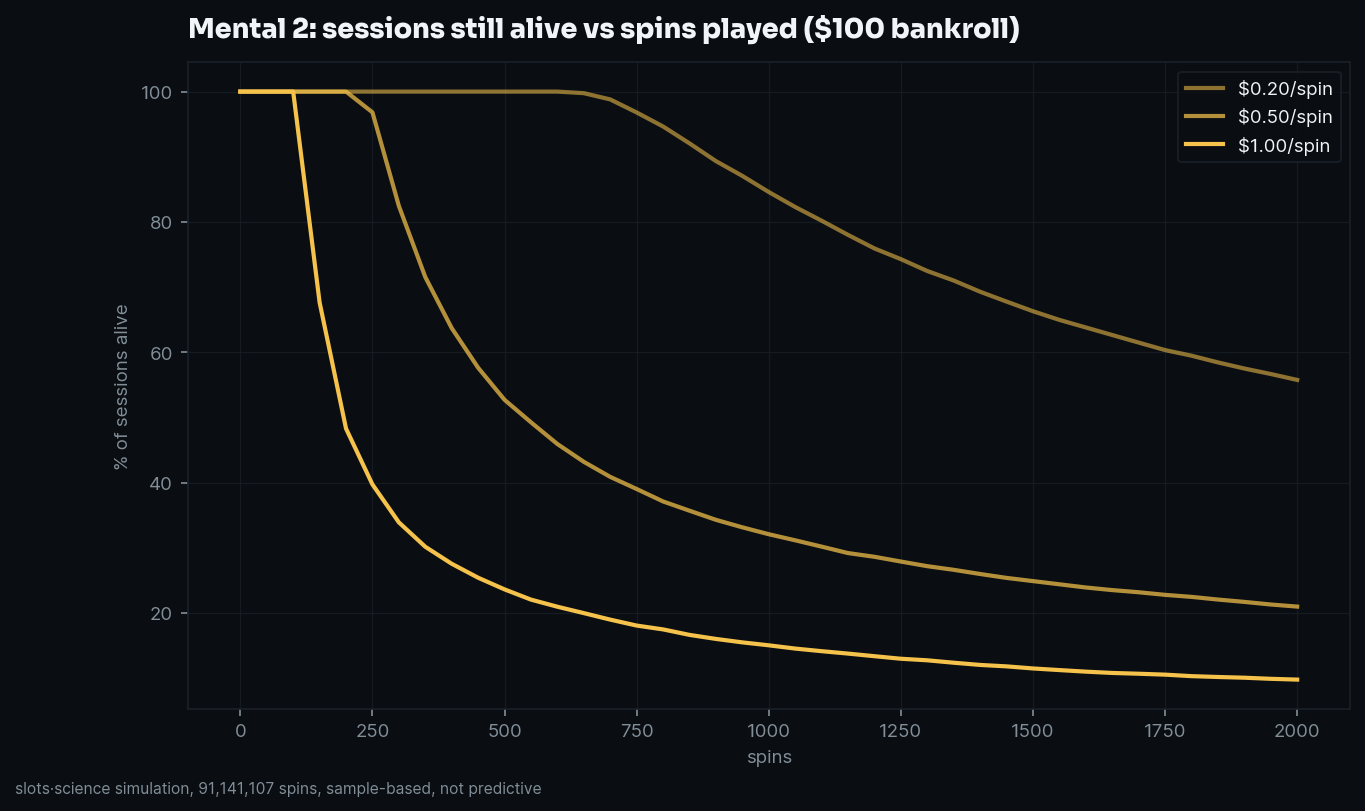
at the $100 bankroll (default config), median session length was 192 spins at $1.00, 537 spins at $0.50, and the full 2,000-spin cap at $0.20. the $1.00/$50 cell is the brutal one: half of those sessions were dead inside 76 spins, against a bonus that arrives once every ~249, most never saw the feature at all. note the $0.20/$50 cell: 73.9% busted despite the minimum stake, the worst minimum-stake/$50 figure we've measured on a nolimit title, when a bonus-heavy engine makes you wait 249 spins for half its value, 250 spins of cover is not cover. the floor compresses everything: at $0.50/$100 the median session fell from 537 spins (default) to 440 (84.01 config).
bust rates
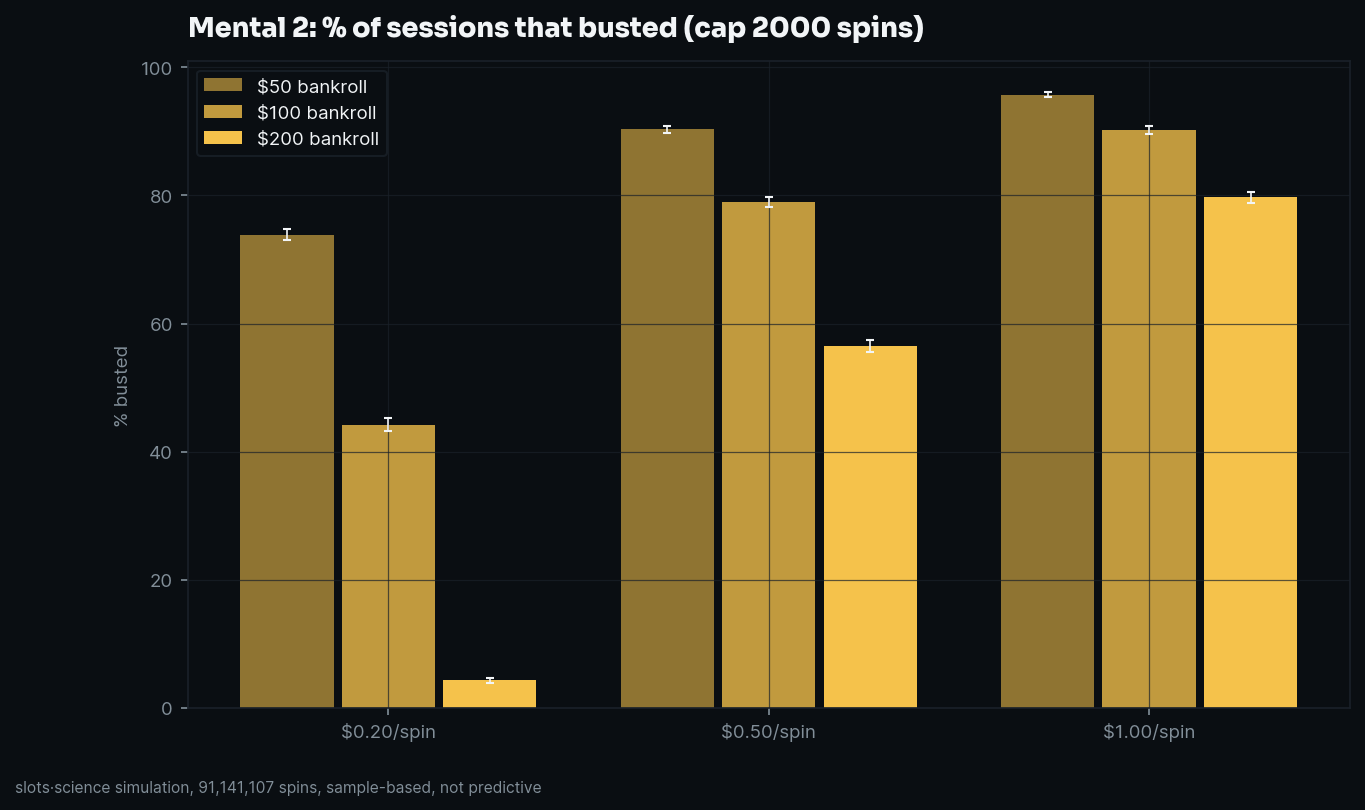
bust rates within the 2,000-spin cap, default 96.06 config, 95% CIs:
| $50 bankroll | $100 | $200 | |
|---|---|---|---|
| $0.20/spin | 73.9% ±0.9 | 44.2% ±1.0 | 4.3% ±0.4 |
| $0.50/spin | 90.3% ±0.6 | 79.0% ±0.8 | 56.5% ±1.0 |
| $1.00/spin | 95.7% ±0.4 | 90.2% ±0.6 | 79.7% ±0.8 |
plain reading: hold the bankroll at $100 and move the stake from $0.20 to $0.50, and the bust rate jumps from 44.2% to 79.0%. the only quiet cell is $0.20 against $200 (4.3% busted), the cell with 1,000 spins of cover, four bonus cycles' worth. winless streaks were short, because the game hits 31.41% of spins (provider-published): the 90th-percentile session's worst dead streak at $0.50/$100 was 20 spins; the longest observed anywhere in 90,000 default-config sessions was 46 spins (a sample observation, not a distribution claim). frequent small hits did nothing for survival, they're how an extreme-volatility game holds your attention while the variance does its work.
the bonus wait, and what it pays
at the provider-published trigger rate of 1 in 249, our simulated sessions averaged one free-spins round every ~249 spins, as expected, that's an input echoing back, not a finding. the payout side rests on our 130x bonus-EV estimate (nolimit publishes no fire-frame or enhancer weight distributions, so the distribution below is a model-based estimate; 365,968 simulated bonuses pooled, default config): the mean bonus paid 130.9x by construction, but the median was 71.0x, half of all bonuses paid less than that. 12.5% paid under 20x; 37.5% paid under 50x, half of what the buy menu charges for the cheapest entry. the top 1% paid 921.6x or more.
a $50 bankroll at $1.00/spin affords 50 spins of cover against a 1-in-249 trigger, those sessions (95.7% busted) mostly ended before the feature existed.
what a finished session looks like
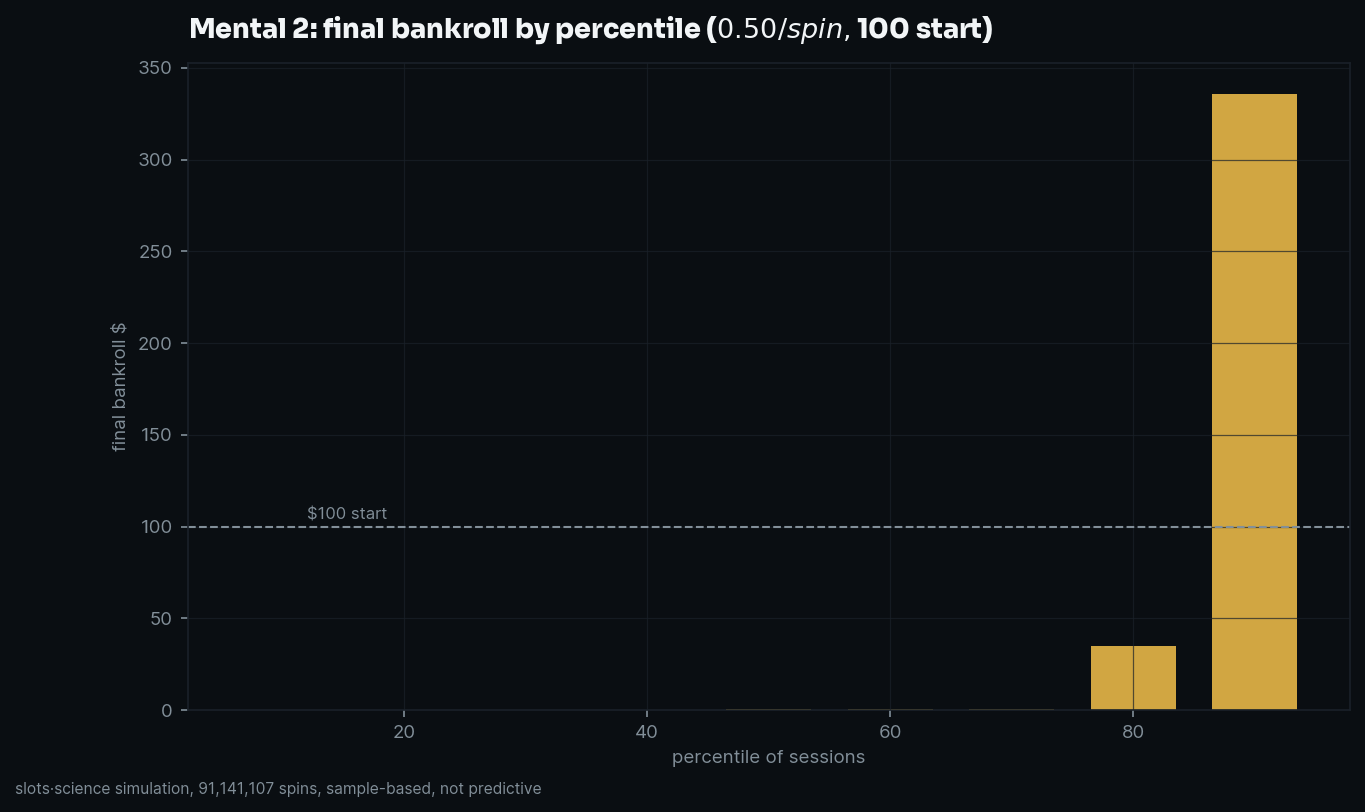
the final-bankroll distribution at $0.50/$100 (default config) has even less middle than usual: half of all sessions ended with $0.33 or less of the original $100, and 70% ended below $0.45, busted, in effect. the 80th percentile kept just $34.67. then the detonation: the 90th percentile kept $335.71. that gap between the 80th and 90th percentile is the entire game in two numbers, when more than half the return rides on a 1-in-249 event, sessions don't end mid-sized; they end empty or they end on a bonus that hit.
the bonus buy math, measuring what nolimit won't publish
this is the section the experiment was designed for. mental 2 sells nine buys, from a 1.4x-per-spin booster to the 6,666x god mode, and no per-buy rtp is published anywhere: not on the provider page, not in any review on file. so let us be precise about what we can and cannot know.
what we cannot know: the actual return of any buy mode, or whether the modes differ from each other. that math exists only inside nolimit's engine. (the original mental carries a third-party-cited buy premium, 96.68 vs 96.08 base; whether the sequel inherits one is exactly the kind of thing nobody outside nolimit can verify.)
what we can measure: what repeated buying does to a bankroll given a stated assumption. our neutral assumption is buy-rtp = base rtp (96.06% of cost), bracketed by a ±2pp envelope (94.06% / 98.06%). every buy figure below is conditional on that envelope and labeled so.
what the menu itself tells us, for free: the lucky draw buy (330x, advertised odds 50% bloodletting / 40% surgery / 10% experimental) is priced at exactly the odds-weighted average of the three direct buys: 0.5×100 + 0.4×250 + 0.1×1,800 = 330. the menu is internally consistent with all three bonus tiers carrying the same rtp, and the arithmetic independently corroborates the advertised odds split, which we otherwise have from a single source. it still says nothing about what that shared rtp is. that's the unpublished number; the pricing only tells us it's probably one number, not three.
simulated outcomes at $0.50 stake, 10,000 sessions per bankroll, neutral assumption, 95% CIs ("couldn't re-buy" = session ended unable to afford another buy, within a 500-buy cap):
| mode | cost per buy | bankroll (buys it affords) | couldn't re-buy | median buys survived | finished in profit |
|---|---|---|---|---|---|
| bloodletting spins, 100x | $50 | $50 (1) | 99.6% ±0.1 | 1 | 0.4% |
| $100 (2) | 98.8% ±0.2 | 3 | 1.2% | ||
| $200 (4) | 96.6% ±0.4 | 12 | 3.4% | ||
| experimental spins, 1,800x | $900 | $900 (1) | 99.5% ±0.1 | 1 | 0.5% |
| $1,800 (2) | 98.8% ±0.2 | 3 | 1.2% | ||
| $4,500 (5) | 95.2% ±0.4 | 18 | 4.6% | ||
| god mode, 6,666x | $3,333 | $3,333 (1) | 99.3% ±0.2 | 1 | 0.7% |
| $6,666 (2) | 98.8% ±0.2 | 2 | 1.2% | ||
| $16,665 (5) | 96.5% ±0.4 | 5 | 3.5% |
the per-buy reality for the two conventional modes (model-based estimates, ~500,000 simulated buys per run): 73.7% of bloodletting buys paid less than the 100x they cost; the median buy returned 46.8x. the experimental mode: 73.7% losing, median 842.2x against the 1,800x price, and the 99,999x cap was reached in sample. under a uniform-rtp assumption the two tables are nearly identical, because price changes the magnitude of the gamble, not its shape, any real difference between the modes lives precisely in the numbers nolimit doesn't publish. we flag the usual shape caveat: both modes use a lognormal payout assumption (sigma 1.2); the real distributions are unknowable from published math.
god mode: the one buy whose math is almost public
god mode is different, and it's why this experiment exists. nolimit publishes the outcome set: one spin chasing an xGod symbol on each of the five reels, 99,999x or nothing. for a two-outcome bet, the unpublished buy-rtp does exactly one job: it sets the win probability, p = rtp × 6,666 / 99,999. no shape assumptions, no sigma, no model to argue with.
so here is the entire assumption envelope, worked out:
| assumed buy-rtp | win probability | share of buys paying zero |
|---|---|---|
| 94.06% (low) | 1 in 15.9 | 93.8% |
| 96.06% (neutral) | 1 in 15.6 | 93.6% |
| 98.06% (high) | 1 in 15.3 | 93.5% |
a 4-percentage-point swing in the unknown moves the win odds from 1 in 15.9 to 1 in 15.3, about half a buy's worth of odds. whatever rtp nolimit set, a god mode buy is, structurally, a roughly 1-in-15.6 shot at 99,999x, and nothing the rest of the time. at $0.50 stake: a $3,333 ticket that pays $49,999.50 or $0.
dollar framing for the bankroll table, because it deserves it: a $16,665 bankroll, five god mode buys, ended unable to re-buy in 96.5% ±0.4 of sessions under the neutral assumption. the median session survived exactly 5 buys, which is the politest way of saying that most five-buy sessions lost all five straight (probability of that, neutral assumption: 71.8%, a model property, not a finding). the median final bankroll in every god mode cell was $0.00; even the 90th-percentile session at the five-buy bankroll finished with $22.95 of $16,665. (those odd crumbs are real arithmetic: $49,999.50 doesn't divide evenly into $3,333 re-buys, a win funds 15 more god modes and leaves $4.50.)
and one column the conventional buys can't match: in this structure, "ever profitable" means exactly one thing, hit the max win at least once. 28.7% of five-buy-bankroll sessions did (neutral assumption; the 99,999x landed mid-session and put them up). only 3.5% finished in profit. the difference is the re-buy loop: a session that hits 99,999x and keeps buying hands it back one $3,333 ticket at a time. that's not a property of god mode; it's a property of buying repeatedly at any negative-expectation price, god mode just makes it visible, because here a "winning session" had, by definition, $49,999.50 in hand at some point.
for context against nolimit's own published number: the 99,999x event occurs about once per 16 million ordinary spins (provider figure). god mode sells the same event at roughly 1-in-15.6 per buy, a million-fold concentration of the same lottery, priced at 6,666 ordinary spins' worth of stake. that is the product. the only number that would tell you whether it's priced fairly is the one that isn't published.
the sensitivity envelope, which is the closing finding: across all nine buy runs, three modes, three assumed rtps, the losing-buy share moved within a band of about 1pp (conventional modes: 73.1-74.3%; god mode zero-pay: 93.5-93.8%), and the five-buy god mode bankroll's couldn't-re-buy rate went 97.1% ±0.3 (low) → 96.5% ±0.4 (neutral) → 96.0% ±0.4 (high). the unpublished rtp governs the margins; the structure governs the outcome. within any plausible setting, most buys lose and most buying sessions end the same way.
the rtp version lottery
mental 2 ships at 96.06% and also exists at 95.23, 94.04, 92.02 and 84.01, a verified 12.05pp spread, the widest nolimit ladder on our files, with the house signature at the bottom: 92.02 drops straight to 84.01 with nothing in between. no deployment scan exists yet for this title (FindMyRTP has no mental 2 page), so we cannot say which version any casino runs, only what the floor does if you're standing on it. measured deltas, same model, same provider-published inputs, only the rtp changed:
| cell | 96.06 default | 84.01 floor | delta |
|---|---|---|---|
| $0.20/$100 bust | 44.2% ±1.0 | 60.6% ±1.0 | +16.4pp ±1.4 |
| $0.50/$200 bust | 56.5% ±1.0 | 69.9% ±0.9 | +13.4pp ±1.3 |
| $0.50/$100 bust | 79.0% ±0.8 | 88.1% ±0.6 | +9.1pp ±1.0 |
| $1.00/$200 bust | 79.7% ±0.8 | 88.4% ±0.6 | +8.7pp ±1.0 |
| $0.20/$200 bust | 4.3% ±0.4 | 11.2% ±0.6 | +6.9pp ±0.7 |
| median session, $0.50/$100 | 537 spins | 440 spins | −97 spins |
the floor raised the bust rate significantly in all nine cells (smallest delta: +1.9pp ±0.5 at $1.00/$50, a cell already 95.7% busted at default). the safest cell in the grid, $0.20 against $200, busted two and a half times as often at the floor. same game, same 99,999x, same god mode button; the difference is a setting the player cannot see, on a ladder whose bottom rung sits 12 points below the number on the box.
(the middle rungs, 95.23 / 94.04 / 92.02, exist in the verified math but have no deployment sightings on file; we did not simulate them.)
methodology note
we simulate models calibrated to published math, rtp, hit frequency, volatility profile, bonus behavior, not the provider's game engine. results are sample-based observations from 171.6 million simulated spins (180,000 sessions across two rtp configurations) plus ~4.5 million simulated feature buys across nine buy-assumption runs, with 95% confidence intervals shown. hit frequency (31.41%) and bonus frequency (1 in 249) are provider-published inputs; average bonus payout (130x) is a documented menu-anchored estimate; per-buy rtps are unpublished and every buy figure is conditional on a stated assumption envelope (94.06-98.06% of cost), not on known math, except god mode's outcome set (99,999x or nothing), which is provider-published; there only the win probability is assumption-conditional. slots are negative-expectation games; nothing here predicts outcomes or improves odds. model and validation data: mental2-v1 (96.06 target, analytic calibration exact, 10M-spin check measured 96.213% ±0.509pp se), mental2-v1@84.01 (measured 84.144% ±0.445pp se), six lognormal buy calibrations analytically exact, three god mode configurations exact by construction (two-point distribution). corrections policy: methodology.html.
Where the max win actually comes from
54% of this game's RTP is locked inside the bonus you rarely trigger; the base game on its own returns just 44%.
A normal spin in our simulation never returned more than ~5,416x (€2,708). The 99,999x top win is a feature event, it only came out of the bonus. (base-game ceiling: paytable-sourced)
Play the Mental 2 demo, or stress-test it
Looking for the Mental 2 demo or free play? A demo shows you a handful of spins. Our free simulator runs Mental 2 across thousands of sessions and shows what actually happens to a bankroll over time: the bust rate, how long the money lasts, and the wait for the bonus. It is the demo with the math switched on.
Every new study, as it publishes
No feed games: one Telegram digest with each study's headline numbers, the week it lands.
get the weekly digest on telegram
FAQ
What is the real RTP of Mental 2?
The default published RTP we modelled is 96.06%. It also ships in lower published versions (ladder: 96.06%, 95.23%, 94.04%, 92.02%, 84.01%), and the casino, not the game, picks which one runs; check the RTP in the game's info panel.
Is Mental 2 a tight slot? How many sessions bust?
In our simulation at the default RTP, 79.0% of $0.50-a-spin sessions on a $100 bankroll busted before the 2,000-spin cap. That is a measured session cost across thousands of simulated sessions, not a prediction for your next one.
How often does the Mental 2 bonus hit?
About once every 250 spins on average in our simulation, roughly 50 minutes at five spins a minute. Real gaps vary widely around that average, and a bonus is never "due".
Is there a Mental 2 demo or free play?
Yes. You can play Mental 2 in demo mode at most casinos, and you can stress-test it free in our simulator, which runs thousands of sessions and reports the bust rate and session length, the demo with the math switched on.
Is Mental 2 worth playing?
It is negative-expectation like every slot. In our simulation, 79.0% of $0.50/$100 sessions busted before the 2,000-spin cap. We report the cost; we never tell you to play.
Related studies
- this slot’s bonus-buy study: what a Mental 2 feature buy actually returns
- Catfish Hunters
- Deadwood
- Duck Hunters
- the full RTP database, how often slots really pay, aggregated
- all 101 studies