
286 million spins on legacy of dead: the version 12 of 16 casinos display busted bankrolls faster in all nine cells
exp · 006 · 2026-06-13 · simulation-based
last updated 2026-07-03
Run it yourself in the live simulator. All figures are simulation-based observations, not predictions. See our methodology.
what we measured
| parameter | value |
|---|---|
| configs simulated | 96.58% (provider default) · 94.51% (modal deployed / CA aggregator headline) · 87.56% (deployed near-floor) |
| known variant ladder | 96.58 / 94.51 / 91.51 / 87.56 / 84.55, a four-source-verified 12.03pp spread |
| stakes | $0.20 / $0.50 / $1.00 per spin |
| bankrolls | $50 / $100 / $200 |
| sessions | 10,000 per stake/bankroll cell, 90,000 per config, 270,000 total |
| spin cap | 2,000 spins per session |
| play model | flat stake, all 10 lines, optional gamble feature not used |
the question this answers: legacy of dead is a top-5 game for canadian players whose canadian aggregator headline matches ladder step 2 exactly, so how do bankrolls actually behave on the version the scan says most casinos deploy, measured against the published default?
model inputs worth flagging: play'n go does not publish hit frequency or bonus trigger rate. we used a single community tracker's large-sample estimates (hit ~22.5%, free spins 1 in 173.7, average bonus 86.43x, from 2.63M tracked spins), low-confidence inputs, documented as estimates. all three configs share them, so the cross-version deltas below are insensitive to that uncertainty; absolute session-length and bonus-gap figures inherit it. (one open spec conflict, whether a retrigger awards +10 or +8 spins, doesn't enter this model, because the bonus is represented by its tracked average payout rather than spin-by-spin; flagged for a demo check anyway.)
how long bankrolls survived
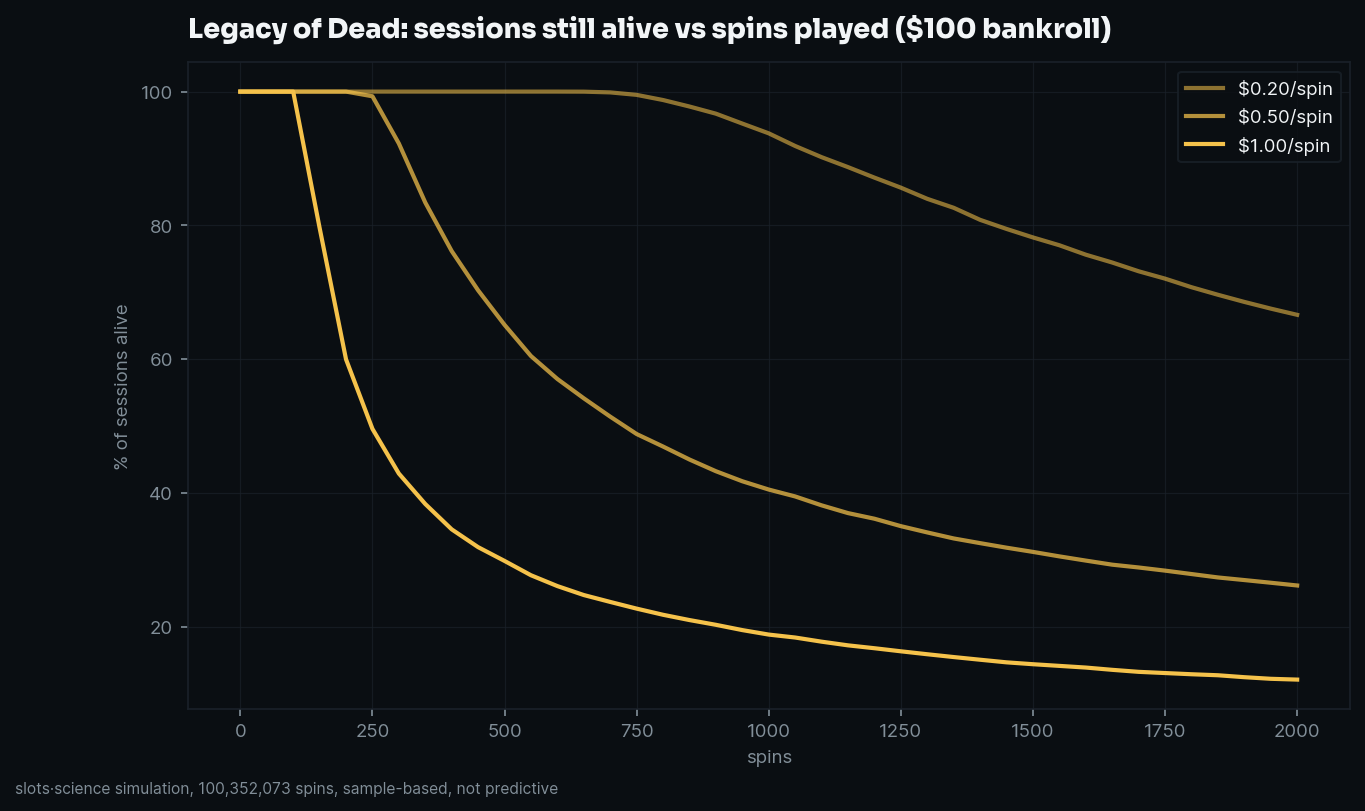
at the $100 bankroll (default config), the stake sets the clock: median session length was 247 spins at $1.00, 726 spins at $0.50, and the full 2,000-spin cap at $0.20, at twenty cents, more than half the sessions were still alive when we stopped counting. the $1.00 curve drops fast and early: half those sessions were dead inside 247 spins, which at real-world pace (~5 spins a minute) is under an hour. the deployed versions compress everything: at $0.50/$100 the median session shrank from 726 spins (default) to 685 (94.51 config) to 546 (87.56 near-floor).
bust rates
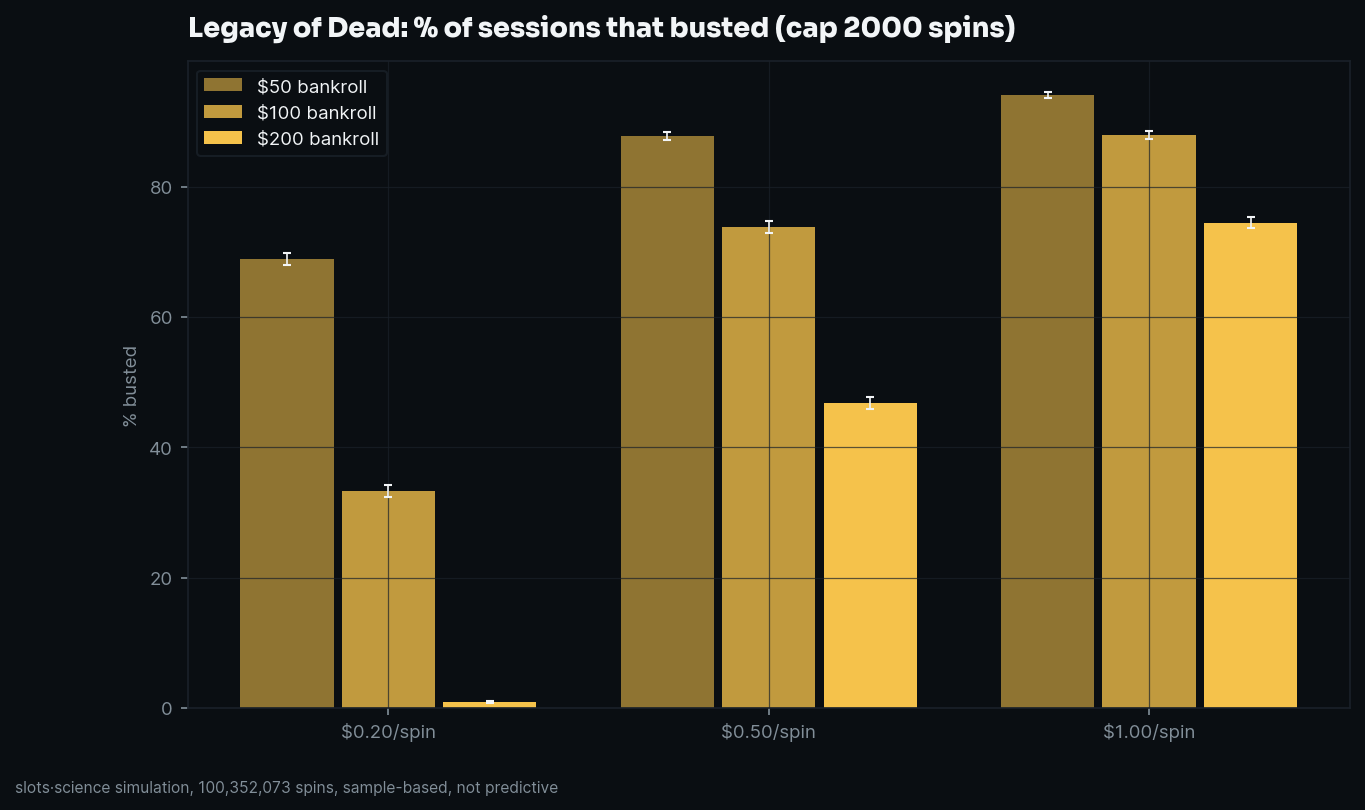
bust rates within the 2,000-spin cap, default 96.58 config, 95% CIs:
| $50 bankroll | $100 | $200 | |
|---|---|---|---|
| $0.20/spin | 68.9% ±0.9 | 33.4% ±0.9 | 0.9% ±0.2 |
| $0.50/spin | 87.8% ±0.6 | 73.8% ±0.9 | 46.8% ±1.0 |
| $1.00/spin | 94.1% ±0.5 | 87.9% ±0.6 | 74.5% ±0.9 |
plain reading: hold the bankroll at $100 and move the stake from $0.20 to $0.50, and the bust rate jumps from 33.4% to 73.8%, the single biggest lever in the grid. the only cell where busting was rare is $0.20 against $200 (0.9%), the cell with 1,000 spins of cover. dead streaks ran long, as a 10/10-volatility rating suggests they would: at $0.50/$100, the 90th-percentile session's worst winless run was 29 spins; the longest observed anywhere in 90,000 default-config sessions was 70 spins (a sample observation, not a distribution claim).
the bonus wait, and what it pays
at the tracker-estimated trigger rate of 1 in 173.7, a model input, and a low-confidence one, our simulated sessions averaged one free-spins round every ~174 spins, as expected. the payout side is where the texture is (model-based estimates; 500,006 simulated bonuses pooled, default config): the average bonus paid 86.2x stake, but the median was 47.2x, half of all bonuses paid less than that. 21.7% paid under 20x, 52.1% under 50x. the top 1% paid 606.8x or more, and the 5,000x cap was reached in sample. that gap between the 86x average and the 47x median is the expanding-symbol engine in one sentence: the average is carried by rare rounds where retriggers stack special symbols, and the typical round pays barely half the number everyone remembers.
a $50 bankroll at $1.00/spin affords 50 spins of cover against a 1-in-174 trigger, most of those sessions (94.1% busted) never saw the feature at all.
what a finished session looks like
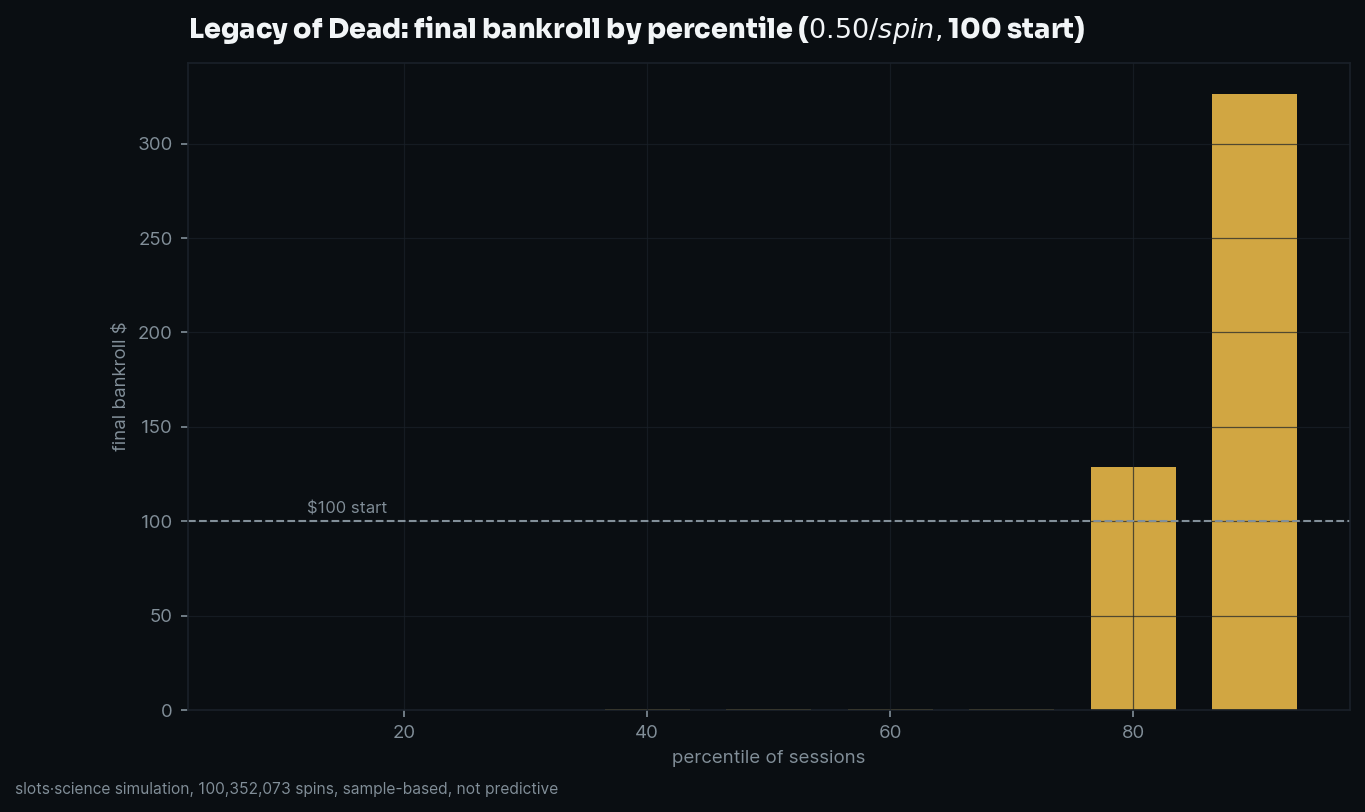
the final-bankroll distribution at $0.50/$100 (default config) has almost no middle: half of all sessions ended with less than $0.35 of the original $100, and 70% ended below $0.47, busted, in effect. then the distribution jumps: the 80th percentile kept $128.92 and the 90th kept $326.32. like its 2016 sibling book of dead, legacy of dead sessions either die or detonate upward, a 10-line, 5,000x-cap engine doesn't do middling.
there is no bonus-buy section in this study: legacy of dead (2019) runs the classic book engine with no feature buy, no multipliers, there is nothing to measure.
the rtp version lottery
this is the study's reason to exist, and it starts with two observations from the librarian's files rather than anything any operator says about itself. first: FindMyRTP's june 2026 scan of 16 casinos found 15 displaying a lower step of the ladder, not the 96.58 default. twelve displayed 94.51, including ontario-licensed mainstream brands, two displayed 91.51, one displayed the 87.56 step, and the sixteenth displayed 96.32, an off-ladder number we record verbatim but do not score as any version (correction (2026-07-03): an earlier revision read that display as the 96.58 default net of rounding; our QA has since found the identical 96.32 figure displayed across unrelated games, so we treat it as a display artifact, and a july 2026 rescan of 24 casinos found 8 showing that same artifact figure and still none confirmed on the certified 96.58). second: SlotCatalog's canada-facing page headlines this game at 94.51%, exactly ladder step 2, to the second decimal. the aggregator number canadian players see and the modal version the scan finds are the same number. for a game ranked top-5 in canada, that is the market telling on itself.
the game ships at 96.58% and also exists at 94.51, 91.51, 87.56 and 84.55, a four-source-verified 12.03pp ladder (house edge 3.42% → 15.45%) that happens to tie book of dead's spread exactly. so we didn't just simulate the brochure; we ran the full grid at the two deployed versions with sightings at the ends of the scan. measured deltas, same model, same inputs, only the rtp changed:
| cell | 96.58 default | 94.51 (12 of 16 scanned) | 87.56 (deployed near-floor) |
|---|---|---|---|
| $0.20/$100 bust | 33.4% ±0.9 | 37.9% ±0.9 (+4.5pp ±1.3) | 51.0% ±1.0 (+17.6pp ±1.3) |
| $0.50/$100 bust | 73.8% ±0.9 | 76.1% ±0.8 (+2.3pp ±1.2) | 83.4% ±0.7 (+9.5pp ±1.1) |
| $0.50/$200 bust | 46.8% ±1.0 | 50.6% ±1.0 (+3.8pp ±1.4) | 63.6% ±0.9 (+16.8pp ±1.4) |
| $1.00/$200 bust | 74.5% ±0.9 | 77.2% ±0.8 (+2.7pp ±1.2) | 83.5% ±0.7 (+9.0pp ±1.1) |
| $0.20/$200 bust | 0.9% ±0.2 | 1.5% ±0.2 (+0.6pp ±0.3) | 4.8% ±0.4 (+3.9pp ±0.5) |
| median session, $0.50/$100 | 726 spins | 685 spins | 546 spins |
the modal deployed version raised the bust rate in all nine cells, and the increase was statistically significant in all nine, its sibling book of dead managed only eight of nine in exp 004. the near-floor was significantly worse in all nine cells as well. the safest cell in the grid, $0.20 against $200, went from 0.9% busted on the default to 4.8% on the near-floor: roughly five times as many busted sessions, purely from which version the casino licensed. a community tracker's realised return of 89.92% over 2.63 million real spins sits below even the modal deployment, a smaller sample than we'd like and context only, but directionally consistent with most tracked play happening on sub-default versions. same game, same sarcophagus, same free spins. the only difference is a setting you can't see.
(the 91.51 step, two sightings, and the 84.55 absolute floor, no sighting on file, were not simulated; both sit inside or below the bracket above.)
methodology note
we simulate models calibrated to published math, rtp, hit frequency, volatility profile, bonus behavior, not the provider's game engine. results are sample-based observations from 286 million simulated spins (270,000 sessions across three rtp configurations), with 95% confidence intervals shown. hit frequency and bonus trigger rate are single-tracker community estimates, used as documented model inputs. casino-by-casino rtp figures are aggregator/scan observations as displayed on the dates cited, not statements by or about any operator's current configuration. slots are negative-expectation games; nothing here predicts outcomes or improves odds. model and validation data: lod-v1 (96.58 target, analytic calibration exact, 10M-spin check measured 97.219% ±0.398pp se), lod-v1@94.51 (measured 95.143% ±0.396pp se), lod-v1@87.56 (measured 88.174% ±0.389pp se), all within tolerance. corrections policy: methodology.html.
Where the max win actually comes from
52% of this game's RTP is locked inside the bonus you rarely trigger; the base game on its own returns just 47%.
A normal spin in our simulation never returned more than ~500x (€250). The 5,000x top win is a feature event, it only came out of the bonus. (base-game ceiling: paytable-sourced)
Play the Legacy of Dead demo, or stress-test it
Looking for the Legacy of Dead demo or free play? A demo shows you a handful of spins. Our free simulator runs Legacy of Dead across thousands of sessions and shows what actually happens to a bankroll over time: the bust rate, how long the money lasts, and the wait for the bonus. It is the demo with the math switched on.
stress-test Legacy of Dead free
Every new study, as it publishes
No feed games: one Telegram digest with each study's headline numbers, the week it lands.
get the weekly digest on telegram
FAQ
What is the real RTP of Legacy of Dead?
The default published RTP we modelled is 96.58%. It also ships in lower published versions (ladder: 96.58%, 94.51%, 91.51%, 87.56%, 84.55%), and the casino, not the game, picks which one runs; check the RTP in the game's info panel.
Is Legacy of Dead a tight slot? How many sessions bust?
In our simulation at the default RTP, 73.8% of $0.50-a-spin sessions on a $100 bankroll busted before the 2,000-spin cap. That is a measured session cost across thousands of simulated sessions, not a prediction for your next one.
How often does the Legacy of Dead bonus hit?
About once every 175 spins on average in our simulation, roughly 35 minutes at five spins a minute. Real gaps vary widely around that average, and a bonus is never "due".
Is there a Legacy of Dead demo or free play?
Yes. You can play Legacy of Dead in demo mode at most casinos, and you can stress-test it free in our simulator, which runs thousands of sessions and reports the bust rate and session length, the demo with the math switched on.
Is Legacy of Dead worth playing?
It is negative-expectation like every slot. In our simulation, 73.8% of $0.50/$100 sessions busted before the 2,000-spin cap. We report the cost; we never tell you to play.
Related studies
- Book of Dead
- Fire Joker
- Moon Princess
- the full RTP database, how often slots really pay, aggregated
- all 101 studies